Photo by Robinson Greig on Unsplash

Just Eat Takeaway have been being bought out by Prosus a tech investor based in the Netherlands. We explore what that might mean for Just Eat's drivers.
Photo by Robinson Greig on Unsplash
There’s a big change coming for Just Eat Takeway (JET) drivers. JET have been being bought out by Prosus a tech investor based in the Netherlands. This means JustEat drivers are now driving for Prosus.
JustEat promises that the takeover will revolutionise their business by bringing artificial intelligence (AI) innovations, whatever that happens to mean. Prosus boasts that integrating the technology will “[boost] efficiency and [strengthen] [JET]'s ability to compete with other players like Uber Eats”.
But what will that actually mean for Just Eat drivers? What can they expect of the new regime?
Just Eat Takeaway (JET) claim to ‘believe in doing business responsibly and having a positive impact’ - but it’s hard to give much credence to that commitment when they have come under fire for sacking people using an automated system without meaningful explanations of why, and without any opportunity for workers to discuss their cases with JustEat management.
JET prefer to use the synonym ‘deactivations’ to describe these black box firings - likely because it gives them some distance between their actions and the devastating consequence to those workers who no longer have access to their income stream.
This existing history with opaque algorithmic management suggests that drivers are unlikely to trust that JET have their best interests at heart as their new owners look toward potentially integrating AI into their system.
How AI systems operate can be notoriously hard to explain - something that will become only more relevant as laws like the EU Platform Work Directive require platform companies to do a better job of informing workers about automated systems and decisions that affect them.
JustEat in the UK have also been progressively worsening their offer to drivers. In 2021 - their Fairwork score in the UK was 6/10 but by 2023 it had fallen to 1/10. (Fairwork is a project that rates digital platforms against 5 principles of ‘fair work’, companies can score up to two points against the principles of: fair pay, fair conditions, fair contracts, fair management, and fair representation). According to Fairwork, in those 2 years, JustEat stopped ensuring minimum wage for workers, stopped mitigating task-specific risks or providing a safety net, ceased ensuring that no unfair contract terms were imposed, and did not provide due process for decisions affecting workers. The UK is a particularly dramatic example, but it’s not the only country where the company is now doing worse - in Germany (where JustEat is known as ‘Lieferando’), the company went from a 7/10 in 2021 to a 4/10 in 2025.
It clearly doesn’t have to be that way - in Belgium (where JustEat is ‘Takeaway’) their score has gone from 6/10 in 2022 to 8/10 in 2025.
So what do we know about Prosus’ record in this area?
One way to find out is to look to Prosus’ oversight of its current Food Delivery platforms portfolio. Most notably, Prosus already wholly owns a food delivery business much like Just Eat. Its name is iFood and it, remarkably, holds over 80% of the food delivery market in Brazil.
IFood have also fallen far short of the fair principles of work outlined by Fairwork - scoring just a 2/10 in 2021, which has degraded even further to a shocking 0/10 in 2025.
IFood claim to have over 124 AI models at use in their business. But what those AI models actually do, how they operate, or what safeguards they employ is remarkably opaque. The pages on Prosus’ website that promise to say more raise a 403 Forbidden error message.
We used the Wayback Machine to see these pages when they were last crawled and working - back in 2023 (screenshots below), the pages primarily discussed an AI system that allows users to shop using voice commands, and one which allows them to use handwritten shopping lists.



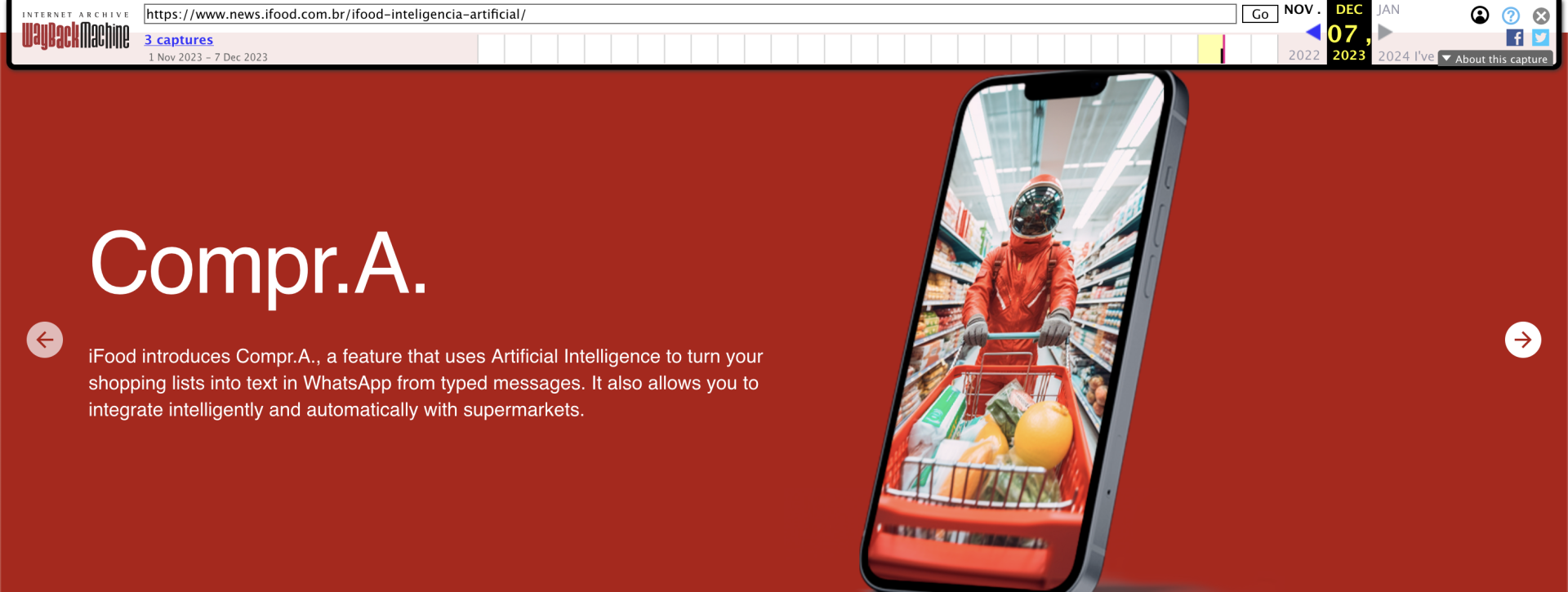
But the other 122? Remain a mystery.
As with JustEast, automated deactivation issues are not unfamiliar to iFood and Prosus – in 2021 Fairwork found that iFood had “clear deficits particularly in relation to fair deactivation policies”. Drivers they spoke to complained about “unfair deactivation by the platform” and told Fairwork that they “spoke to a machine, not to a person.”
Moreover, in 2025, iFood were ordered to pay R$60,000 in compensation to a black delivery driver – Tiago Alves – who accused the company’s automated facial recognition driver verification systems of racism when he was locked out of the app after submitting a photo which iFood claimed to be of someone else. The Judge considered that the conduct of iFood violated Mr Alves’ human dignity and agreed that iFood’s platform had committed a racist failure.
Drivers in Brazil have raised serious concerns over the working conditions they face thanks to iFood, highlighting problems over pay, dangerous conditions and algorithmic issues that lead to accounts being blocked or deactivated, issues with payments, and problems with routes.
Union supporters even say they are targeted by the company’s algorithm. A report from 2022 found that iFood were willing to take disturbing steps to control workers, including monitoring WhatsApp groups, creating fake profiles on social networks and even infiltrating a protest. This deeply concerning pattern of surveillance behaviour led to three government investigations into iFood and led to iFood having to sign an agreement that they compensate for these actions and should not be able to undertake them again.
While this agreement was signed in 2023, as of 2024 drivers continued to assert that iFood violate their rights, and in 2025 drivers participated in a 48-hour National strike.
The European Competition Authority have given their approval to the Prosus takeover of JET – after Prosus agreed to reduce their stake in Delivery Hero, a European JustEat competitor they already owned 27.4% of. Delivery Hero - along with Glovo, another delivery company it had acquired sole control of - were recently fined over 329mn euros for taking part in a cartel, which included an agreement “not to poach each other’s employees”.
In Brazil, iFood have been in trouble with competition authorities too. Brazil’s competition regulator (CADE) found that they may have punished restaurants using their restaurant ranking and driver allocation algorithms, preferencing those who had signed exclusivity deals over those who had not.
It should be noted that – whilst not traditionally considered as part of a Competition Authority’s mandate – market concentration has implications for workers. The European Trade Union Confederation (ETUC) notes that “increasing corporate concentration directly feeds into a wider reliance on unfair labour clauses”. But if Prosus do make working conditions for drivers worse, then drivers may be disappointed (if not surprised) to find that their other options - big figures including Deliveroo and Uber Eats have received huge fines in recent years for violating their drivers’ rights.
Deliveroo received a huge €2.5 million fine from Italy’s data protection agency for systematically inappropriate and unlawful processing of the personal data of around 8,000 of its workers, and were sentenced by the Paris Criminal Court in 2022 to pay a fine for “a willful infringement of employment law”.
Uber were hit with €584,000 in penalties after failing to comply with a court order that required them to disclose information to allow drivers to challenge their robo-firings. They also recieved a €10 million fine from the Dutch data protection agency for breaching their driver’s privacy rights and a €290 million fine only months later, again for inadequately protecting their driver’s data protection rights, following 170 complaints filed by French Uber drivers.
JustEat Takeaway’s outgoing boss Jitse Groen said it best when he said that the gig economy “led to precarious working conditions” and “comes at the expense of society and workers themselves”.
For JustEat drivers the options are not good. Few companies are competing to offer them a better workplace, instead there seems to be a new race to the bottom for workers’ rights.
In fact, even Naspers (Prosus’ parent company) shareholders have been applying pressure about the treatment of delivery workers employed by iFood, and the potential for those labour practices to spread across the Naspers group. In August 2024, at Naspers’ AGM, SHARE (Shareholder Association for Research and Education) raised concerns that Fabricio Bloisi – the new Prosus CEO who had previously run iFood for many years – would oversee the extension of iFood’s controversial labour practices.
What will this actually mean for Just Eat delivery drivers? At the moment, we quite simply don’t know. And neither do they.
We don’t know which AI models Prosus intend to integrate into JustEat. We don’t even know what the 124 AI models they claim they are already using in iFood do or how they work - or even whether they work.
What’s important is that takeovers like this one may create further downward pressure on the rights and working conditions of JET drivers. We’ve seen how gig economy companies have historically utilised algorithmic management in their platforms, and seemingly shrugged off the harms and concerns raised by workers, unions, and authorities.
Working conditions were already harmful for JET drivers, but a new investor changeover poses an opportunity for change and transparency. At the very least, food delivery workers deserve to better understand how they’re being treated by the platform’s algorithms and according to what parameters decisions affecting their work are being made.
PI has produced three demands that platforms relying on automated decision-making to manage their workers should implement, including concrete and detailed examples of what best practices look like. Prosus - and any other company looking to get involved in the gig economy - need to face up to the responsibilities they have to their workers, who are after all the people who are ultimately the ones driving their profits.
Demand 1: Maintain a public register of the algorithms used to manage workers
Demand 2: Accompany all algorithmic decisions with an explanation of the most important reasons and/or parameter(s) behind the decision and how they can be challenged
Demand 3: Allow workers, their representatives and public interest groups to test how the algorithms work