Image collage of drone, military personnel, and woman with remote

This company profile put together in collaboration with Corporate Watch explores an example of militarisation of tech: a convergence of corporate interests and state power, that inevitably blurs what should be very clear boundaries between civil and military domains.
Image collage of drone, military personnel, and woman with remote
Technologies that have both military and civilian applications are known as "dual-use”. Drone start-ups, arms giants, and satellite manufacturers are among the tech companies which are increasingly marketing surveillance products for both military and civil applications, leading to a blurring of the lines between the two domains. This has serious implications for our freedoms, and the militarisation of our societies, and the use of publicly-funded research.
Exploring the growing influence of dual-use surveillance technologies, this series highlights ten companies and their products, among them Anduril Industries, Inc. This set of profiles aims to demonstrate how technologies developed for the battlefield are increasingly shaping civilian life, and vice-versa. Additionally it seeks to support civil society and investigations to shed light on the opaque corporate structures and public–private partnerships that enable unlawful surveillance and repression, often shielded from scrutiny by the pursuit of profit. By tracing these connections and funding flows, the series also highlights how public money is fueling a global market for dual-use technologies with far-reaching social and political consequences.
Anduril Industries, Inc. is a US military technology company specialising in autonomous surveillance products and weapons. These products minimise the need for a human role in deciding when and how they are deployed, providing the potential for a horrific escalation of state power. An avid gamer, its founder, Palmer Luckey, made his fortune by designing virtual reality headsets, and Anduril makes the experience of operating its warfare and border policing products “exactly like playing a videogame”. This gamification of warfare is just one part of the company’s carefully cultivated public image as a disruptive newcomer upending the arms industry.

Since its founding in 2017, Anduril has achieved rapid growth. Part of its recipe for success has been a blend of venture capital investment, government contracts and state subsidies, a pattern which follows the growing trend of public contracts being awarded to Silicon Valley-backed start-ups. The most significant civilian deployments of Anduril’s systems are for border control purposes, fuelled by the rise in xenophobic policies in the US and UK. However, given its breakthroughs into public sector contracts and ability to secure billions in private funding, we can expect to see Anduril products gaining greater prominence in the years to come.
Anduril markets its flagship software Lattice as a platform for “public safety, security and defense” applications. Lattice is a command and control software, meaning a system that aggregates and analyses surveillance data from multiple sources (such as cameras and sensors), in order to facilitate decision making. Anduril’s product uses artificial intelligence (AI) and machine learning (ML) to operate an array of hardware, including autonomous surveillance equipment and lethal munitions. Lattice Mesh extends these capabilities to other companies’ technologies: Anduril promotes a partner programme and software development kit on its website to make it easier for developers to integrate Lattice with their hardware.
Lattice has been adopted by branches of the US and UK military looking to advance the automation of warfare. Anduril won a three-year agreement with the US Department of Defense for Lattice Mesh, and has been awarded a $100m contract to lead on the creation of NGC2, a next generation command and control system for the US Army (incorporating technology from Palantir and Microsoft). The British military has been using Lattice as part of Project ASGARD (which stands for Autonomous Strike Guidance and Reconnaissance Device), the army’s digital system aimed at doubling its “lethality” by 2027, and tripling it by the end of the decade. It aims to do this by increasing the speed of target identification and decision making, all from longer distances. According to Chief of General Staff, General Sir Roly Walker, “ASGARD…exponentially reduces the time to see, decide, and strike. What took hours, now takes minutes”.
Anduril also sells AI-powered surveillance systems for the purposes of securing military installations. In 2019, the US Marine Corps became an early adopter of Anduril tech for base protection, having struck a $13.5m deal for Lattice and for Sentry, Anduril’s surveillance towers. In 2025, it took out a far larger $642m contract for Anduril’s counter-drone system. Meanwhile, the UK Ministry of Defence has been exploring “force protection” with Anduril as part of Project TALOS, which in 2023 resulted in Anduril winning a £17m contract to protect military assets. TALOS includes a project to guard UK military sites in Cyprus, including RAF base Akrotiri – a key hub for Britain’s role in the latest phase of Israel’s atrocities against Palestinians. In a deal worth up to $100m, US Space Systems Command has also contracted Anduril to use Lattice Mesh for its space surveillance network.
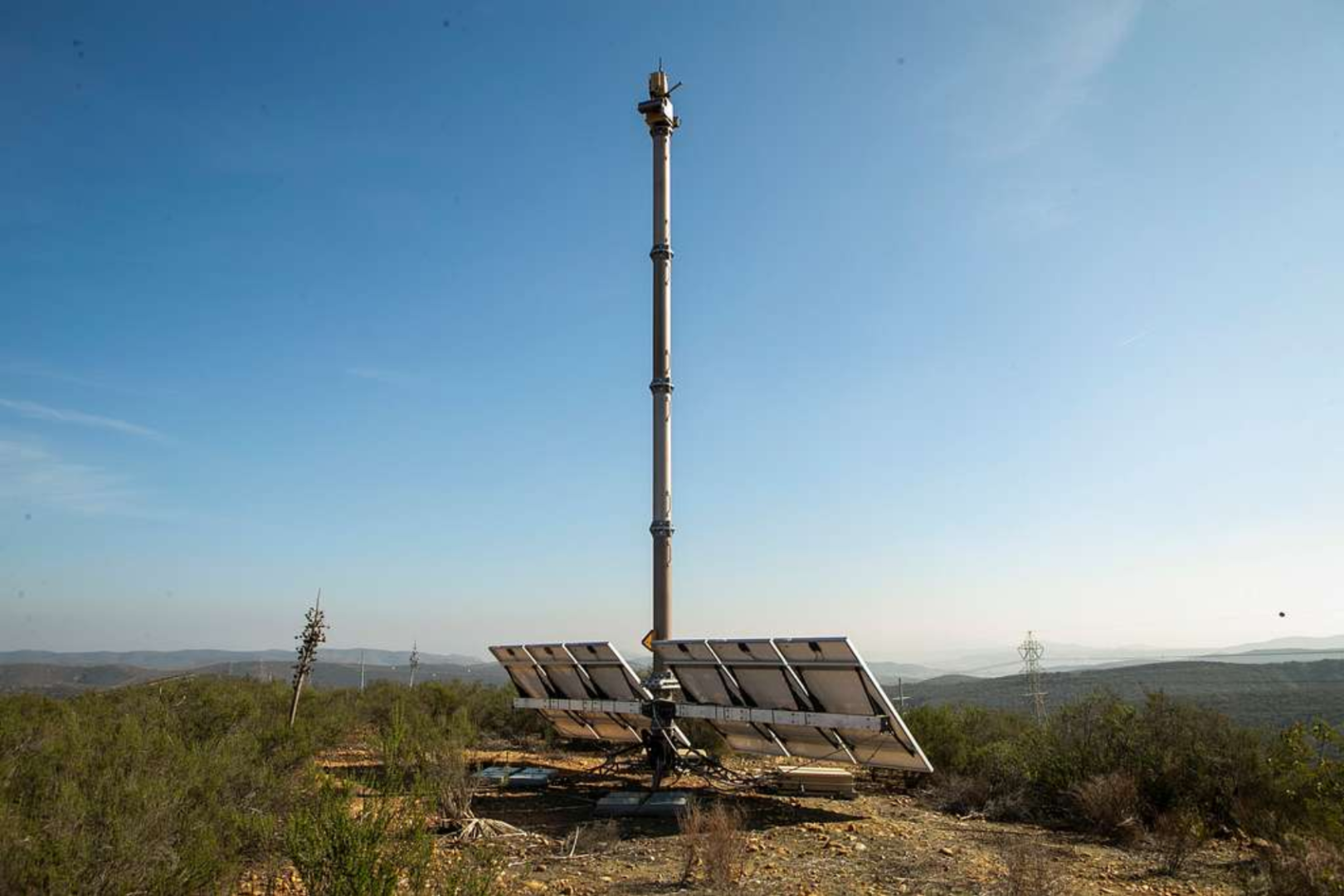
Commercial applications for Lattice cited by Anduril include the maintenance and protection of critical infrastructure, oil and gas pipeline monitoring, and search and rescue operations. But to date its primary application outside military use has been border enforcement. The militarisation of borders has been a priority for Anduril since its inception: in June 2017, the same month the company was founded, it began pitching border surveillance products to the Department of Homeland Security, leading to pilot programmes with the latter’s Customs and Border Protection (CBP) division in San Diego and Texas. The result was a $250m, five-year contract with the CBP to deploy Anduril’s Sentry range of solar-powered automated surveillance towers, operated via Lattice.
Sentry autonomously scans the vicinity and classifies and tracks “objects of interest” – in this case migrants attempting to cross the border. It comprises a collection of sensors atop a 33ft (10m) pole: electro-optical cameras with thermal imaging, and radar equipment sourced from other dual-use manufacturers such as Fujitsu and B.E. Meyers. The data collected by Sentry’s sensors feeds into Lattice, which uses AI and machine learning web browser displays, and other technology like VR headsets, to enable and visualise the detection of people. Agents are alerted to incidents and presented with options on how to respond – tasks that can be assigned to border force personnel, or even to other autonomous technologies.
Anduril markets the towers as a dual-use, with military, border monitoring, commercial security, law enforcement, and search and rescue purposes listed as potential applications pitched on its website.
In addition to the standard model, other iterations have been developed by Anduril through its partnership with US Customs and Border Protection (CBP) for use in border enforcement. These include a Cold Weather Sentry Tower, which has been deployed at the country’s northern border; a Maritime Sentry Tower, which can detect boats and “other water-borne objects”; and a trailer-mounted version called Mobile Sentry. Meanwhile, the 80ft tall Extended Range Sentry Tower can target people up to 7.5 miles (12 km) away, and has been in use on the border with Mexico since May 2024.
Once Sentry detects a person of interest, among the tools deployed to investigate is Ghost, an autonomous intelligence-gathering drone. Ghost has a modular payload design, meaning it can be customised with different sensors and other systems; from loudspeakers to electronic warfare equipment, and even munitions. Options for electro-optical and infrared cameras include Trillium Engineering’s HD45, Next Vision’s Raptor and Hoodtech’s Alticam 06. There have been a number of variants of the drone, the latest being Ghost-X, which can be dispatched to track and surveil a person flagged by a Sentry tower. Besides its use on the US-Mexican border, Ghost has been supplied to both the US and UK militaries.
By late 2024, the 300th Sentry tower had been installed for CBP, meaning the company’s technology is now used to enforce almost a third of the US’ border with Mexico. The Electronic Frontier Foundation (EFF) has been mapping the locations of these towers and will have plenty more work to do in the coming years: Trump’s One Big Beautiful Bill Act, signed into law in July 2025, grants a further $6bn for border security technology. All new surveillance towers are required to be certified autonomous by CBP, and only Anduril’s technology currently has this certification, meaning it enjoys an effective monopoly.
In the UK, Anduril technology has played a key role in the detection and interception of refugees in the Channel since at least 2022. Most visibly, the Home Office employs Anduril’s Maritime Sentry Towers to scan for small boats at a range of over 20km from the shore. As with the US border, we rely on activists and journalists for the locations of the towers, which have been extensively documented by Migrants Rights Network among others.
However, Anduril’s role at the UK-French border goes far beyond Sentry. Lattice is the key software in the Home Office Joint Control Room, based in Dover, from which the entire operation is conducted. Lattice brings together surveillance data from a range of sensors and radars to track vessels in the Channel. Information has been supplied to the Lattice system by surveillance aircraft including two de Havilland Canada Dash 8 (DHC-8) planes operated by PAL Aerospace, RAF P-8 Poseidons (a military variant of a Boeing commercial liner), an RAF Atlas 400M made by Airbus, and Tekever’s AR3, AR4 and AR5 drones. Further aircrafts are operated by 2Excel Aviation, and others, like the s100 drone, supplied by Bristow helicopters for use by the Maritime and Coastguard Agency. One of the payloads in use is the Artemis IMSI catcher, supplied by PAL Aerospace subsidiary, Cartenav. This technology, according to the company’s website, locates individuals – in this case, refugees in small boats – via their mobile phone signals.
Initially worth £16m over three years, Anduril’s UK Home Office contract has now been extended to 2026, netting the company £21m in total. It’s safe to assume the current tender for a further year will end up being yet another extension. Anduril’s integration with the Ministry of Defence seems set to automate, entrench and intensify the militarisation of the Channel.
Anduril has rapidly accumulated a plethora of high-profile AI partnerships. The key partner in this enterprise is Palantir, a company which has been thoroughly enmeshed with Anduril since its founding. In December 2024, the two companies announced a consortium with SpaceX, OpenAI, Saronic, Scale AI, and others to bid for Pentagon contracts and drive the adoption of AI for military purposes. The idea was that Anduril’s Lattice and Menace products would be used to capture huge amounts of military data for AI and machine learning training, which would then be managed and exploited using Palantir’s AI Platform. Anduril’s Lattice would also be joined with Palantir’s Maven Smart System, which was developed for the US military, to enable the deployment of new AI applications.
AI and national security were also at the heart of Anduril’s partnership expansion with Microsoft, announced in February 2025, to take over the development and delivery of the US military’s $22bn Integrated Visual Augmentation System (IVAS) contract. The two companies had already worked together to integrate IVAS, a headset for US soldiers, into Lattice.
As of May 2025, Anduril is working with Meta on the creation of extended reality military products, integrating augmented and virtual reality interfaces with Lattice. The companies have made a joint submission for the IVAS successor contract Soldier-Borne Mission Command (SBMC Next).
Ukraine has been a testing ground for Anduril products since the very start of the war. Despite concerns raised about autonomous weapons systems by campaigns such as Stop Killer Robots, the UK government recently signed a deal bankrolling Anduril to supply Ukraine with loitering munitions.
With so much data being captured and stored for surveillance and AI training purposes, there are also grave concerns for the privacy implications of Anduril’s tech. In the case of the US border, there are entire towns that sit in areas being scanned by Anduril Sentry towers. A report by the US Government Accountability Office found serious policy failings involving the use of automated surveillance towers at the border.
With the help of specialist defence and security PR firm VRM Advisory, Anduril has, according to Politico reporting, expended considerable effort lobbying successive UK governments for contracts. It has reportedly courted politicians, joined industry lobby groups, and been a fixture at a number of prominent UK arms fairs. At the Security and Policing fair in 2025, one attendee reported that the installation of the Sentry towers for the Home Office had initially been a loss leader for the company, meaning the product was sold not so much to make a profit but to attract publicity and clientele. Given the central role Lattice now plays at the border, if that was a gamble Anduril took, it has paid off spectacularly.
In March 2024, during a Q&A with UK Border Force Director General, an Anduril employee suggested that there could be an expansion of the coastal Sentry tower deployment, on the grounds that the existing dragnet would drive crossings further north and south. Staff have also revealed that they would like to see the towers established on the French side of the Channel to intercept migrants at an earlier stage of the crossing.
Anduril’s founder is billionaire Palmer Luckey - a Trump-supporting libertarian. Luckey became a multi-millionaire in his early 20s through the sale of his virtual reality headset company, Oculus, to Meta. Attempting to create a contrarian, provocative and carefree personal image, Luckey blends elements of California’s counterculture with his dystopian vision for humanity. According to reports, he once lived in a shared home he called‘the commune’ in a wealthy Silicon Valley neighbourhood. His social media account is littered with posts on Pokémon and Game Boy, punctuated by promotional content from Anduril for killer drones. Luckey once designed a virtual-reality headset which would, according to Vice, kill the wearer if they died in the game.
40% of Anduril’s leadership is made of former Palantir personnel. This includes former Palantir engineer, Anduril co-founder and Executive Chairman Trae Stephens. 9/11 spurred Stephens on to study Arabic and work for US intelligence services. Stephens is also a partner at Founders Fund, another organisation of critical importance to Anduril’s story (more below).
Anduril is a private company which has relied heavily on venture capital investment to get off the ground.
Key to Anduril’s rise is investor Peter Thiel and his Founders Fund (FF), a powerful venture capital firm, which has provided core financial backing to the defence company since its early days. Thiel deserves his own essay, not appearing here for the first time. Thiel launched FF in 2005 as a young multimillionaire, having recently sold PayPal and co-founded Palantir. He donated $1.25m to the 2016 Trump campaign, after which he reportedly became a member of Trump’s transition team in an undisclosed role. He brought future Anduril co-founder Trae Stephens with him to lead the transition for the US Department of Defense. In 2022, Thiel was a primary funder to the senatorial campaign of US vice president, JD Vance (who is also an Anduril investor, via his fund Narya). Besides Anduril, FF has also invested in Palantir, SpaceX, and OpenAI.
Luckey decided to move into defence tech after meeting Trae Stephens at a retreat hosted by FF. The pair reportedly pitched the business to Palantir directors, becoming the latter’s head of engineering and cementing the ties between Anduril, Palantir, and FF. In committing $1bn to Anduril for its 2025 series G funding, FF recently made its largest investment to date.
Another early Anduril backer is venture capital firm Andreessen Horowitz, also known as a16z. The firm has invested in many well-known technology companies, including dual-use drone manufacturer Skydio, and has posted tips for start-ups looking to contract with the US Department of Defense. a16z is owned by Marc Andreessen and Ben Horowitz. In 2024, the company reportedly became one of the most active foreign investors in Israeli companies. This has included, according to CTech, targeting the elite alumni of IDF units for potential seed funding for any start-ups they have founded or are considering.
Altius** - a drone which can be launched from land, sea or air for surveillance, electronic warfare and as a loitering munition for kamikaze missions. It is built on a commercial, modular platform and is expressly marketed as dual-use. Altius-600 was selected for the Pentagon’s Replicator initiative.
Bolt - a small drone that can be carried and launched by a single person. It has a modular design meaning it can be used as a lethal munition, for surveillance missions, or for search and rescue purposes.
Copperhead - underwater drone akin to a torpedo that includes explosive variants and options adapted for surveillance, with search and rescue and critical infrastructure inspection capabilities highlighted on Anduril’s product webpage. It can be deployed from other drones, underwater autonomous vehicles like the Dive-XL, and autonomous surface vehicles.
Dive-LD - an underwater drone for surveillance, deep water survey, and inspection purposes, with both defence and commercial applications. Anduril collaborated with the National Offshore Wind Research and Development Consortium to demonstrate Dive-LDs’ capabilities for inspecting submerged power cables for wind farms at sea.
Dive-XL - an extra-large autonomous underwater vehicle (XL-UAV) also known as Ghost Shark, which has been developed in conjunction with the Royal Australian Navy at a dedicated factory by Anduril Australia. It has both defence and commercial applications and, like the Dive-LD, it can be used for surveillance or to launch other autonomous hardware.
Menace - a range of portable command, control, communications and computing (C4) systems for the military that come in a number of formats: Menace-I is packed into a shipping container; Menace-X is vehicle mounted; and Menace-T is designed to be carried by soldiers. Whilst dual-use capability is not mentioned in promotional materials, it has been used in conjunction with commercially available military products made by other companies, such as Palantir Edge.
Wisp - Wide-area Infrared System for Persistent Surveillance. This is a sensor that has dual-use land, sea and air applications such as base protection, border enforcement, maritime security and counter-drone systems.