
Search
Content type: News & Analysis
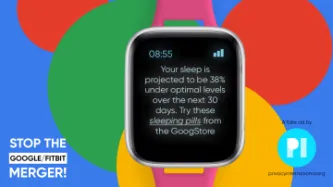
Today, the European Commission has concluded its Phase II in-depth review of the proposed acquisition of the health and fitness tracker Fitbit by Google, deciding that the merger can go through. While we welcome the commitments put forward by Google to mitigate some risks of compromising individuals' rights and competition, PI considers the effects of this merger will further strengthen Google's capacity to exploit our data.
On 15 June 2020, Google formally notified the European Commission of…

Content type: Guide step
Changing settings in Firefox menu
To change basic privacy settings in Firefox, access the preferences menu by clicking on Edit > Preferences on the menu-bar, or by entering about:preferences in the URL bar, and then click on Privacy & Security (Fig. 1).

Content type: News & Analysis
Back in June, we published our investigation into Facebook brands, highlighting how Facebook failed to provide its users with a fair and meaningful understanding of how targeted advertising operated on its platform, and a number of issues preventing users from exercising their rights to the fullest possible extent. In face of the serious gaps encountered, we published an open letter to Facebook drawing attention to four main issues as well as our recommended actions to tackle them. This letter…

Content type: News & Analysis
Banning TikTok? It's time to fix the out-of-control data exploitation industry - not a symptom of it
Chinese apps and tech companies have been at the forefront of the news recently. Following India's ban of 59 chinese apps in July, President Trump announced his desire to ban TikTok, shortly followed by his backing of Microsoft's intention to buy the US branch of its parent company ByteDance. Other than others lip syncing his public declaration, what does President Trump fear from this app, run by a firm, based in China?
It's all about that data
One clear answer emerges: the exploitation of…

Content type: News & Analysis
In September 2019, PI published the report Your Mental Health for Sale. Our investigation looked into popular mental health websites and their data sharing practices.
Our findings suggest that, at the time of the research, most websites we looked at were using third party tracking for advertising purposes, sometimes relying on programmatic advertising technologies such as Real Time Bidding (RTB), sharing personal data with potentially thousands of actors. Some websites were also found sharing…

Content type: Explainer
Hello friend,
You may have found your way here because you are thinking about, or have just submitted, a Data Subject Access Request, maybe to your Facebook advertisers like we did. Or maybe you are curious to see if Policing, Inc. has your personal data.
The right to access your personal data (or access right) is just one of a number of data rights that may be found in data protection law, including the European Union's General Data Protection Regulation, better known as "GDPR", which took…

Content type: Long Read
Introduction
In August 2019, when Facebook announced a few new features for advertisers such as ads in search, PI decided to take an in-depth look at what features the company offers its users when it comes to understanding its advertising practices. One of these features, which caught our attention is Facebook Ads Preference, a tool that among other things, lists businesses/advertisers that have uploaded your personal data to target you with (or exclude you from) ads on the platform.

Content type: News & Analysis
GDPR was hard won. PI, together with other civil society actors, fought from the beginning for a version of the law that offers the strongest rights and protections in the face of intense industry lobbying.
Holding the hidden data ecosystem to account
Two years ago, we committed to using GDPR to seek to hold to account the hidden data ecosystem - those companies that amass and exploit large amounts of our data for profit.
Here’s some of the action we’ve taken:
In Nov 2018,…

Content type: Advocacy
For a long but fun analysis of the current competition and data state of play in the UK, click here.
Background
PI broadly welcomes the CMA’s interim findings, many of which correspond with issues of longstanding concern to PI and with the points raised in our response to the CMA’s Statement of Scope.
This includes the indication that Google and Facebook have a dominant or strategic position in major elements of the digital advertising market which can -at least, partially- be attributed to the…

Content type: News & Analysis
Political campaigns around the world have turned into sophisticated data operations. They rely on data- your data- to facilitate a number of decisions: where to hold rallies, which States or constituencies to focus resources on, which campaign messages to focus on in which area, and how to target supporters, undecided voters, and non-supporters.
While data driven political campaigns are not new, the granularity of data available and the potential power to sway or suppress voters through that…

Content type: Long Read
This review is based on information in the public domain, primarily that of the platforms themselves. It is not exhaustive and this field moves with speed - however, it aims to offer a snapshot of approaches and practices.
TikTok
TikTok is a short-form video app (owned by ByteDance) which allows advertising and sponsored content. Two thirds of TikTok’s over 113 million users (are reportedly aged 16-24) and it was the second most downloaded app in 2019, beaten only by WhatsApp’s 849…

Content type: Case Study
Over the past decade targeted advertisement has become exponentially more invasive. To enable targeted advertisement, massive amounts of data about individuals are collected, shared and processed often without their knowledge or consent. This information about us is then used to profile us and micro-target us to sell us products or influence our views.
This is a significant intrusion to our privacy inevitably affects our perogative not to reveal our thoughts; not to have our thoughts…
Content type: Examples
The US Centers for Disease Control and Prevention, in conjunction with local and state governments, are using location data collected by the mobile advertising industry from millions of cellphones in order to better understand how Americans are moving during the COVID-19 pandemic and how those movements affect the spread of the disease. The goal is to create a portal that federal, state, and local officials can use to study geolocation from up to 500 US cities and see which retail…

Content type: Long Read
In 2018, following the Cambridge Analytica scandal, Facebook announced the “Download Your Information” feature allowing users to download all the information that the company have on them since the creation of the account. All of it? It doesn’t seem so. Concerns were quickly raised when Facebook released the feature, that the information was inaccurate and incomplete.
Privacy International recently tested the feature to download all ‘Ads and Business’ related information (You can accessed it…

Content type: Explainer
Television offers some of the earliest instances of digital marketing. The majority of television channels rely on commercials and advertisements to maintain their operations. For the past 75 years, TV adverts have been passive transmissions broadcast to viewers, the demographics of the channels audience guiding the kinds of products and services shown during commercial breaks and intermissions. With the changes in the way individuals are now consuming content however, broadcasters are trying…