
Search

Content type: Advocacy
Privacy International had suggested the Human Rights Committee consider the following recommendations for the UK government:Review and reform the IPA 2016 to ensure its compliance with Article 17 of the ICCPR, including by removing the powers of bulk surveillance;Abandon efforts to undermine the limited safeguards of the IPA 2016 through the proposed Investigatory Powers Amendment Bill;Refrain from taking any measures that undermine or limit the availability of encrypted communications or other…

Content type: News & Analysis
A new report by the UN Working Group on mercenaries analyses the impact of the use of private military and security services in immigration and border management on the rights of migrants, and highlights the responsibilities of private actors in human rights abuses as well as lack of oversight and, ultimately, of accountability of the system.
Governments worldwide have prioritised an approach to immigration that criminalises the act of migration and focuses on security.
Today, borders are not…

Content type: Explainer
In the name of reinforcing migration control and increasing security, the EU is introducing a host of new surveillance measures aimed at short-term visitors to the Schengen area. New tools and technologies being introduced as part of the visa application process and the incoming “travel authorisation” requirement include automated profiling systems, a ‘pre-crime’ watchlist, and the automated cross-checking of numerous national, European and international databases. There are significant risks…

Content type: Long Read
Over the last two decades we have seen an array of digital technologies being deployed in the context of border controls and immigration enforcement, with surveillance practices and data-driven immigration policies routinely leading to discriminatory treatment of people and undermining peoples’ dignity.And yet this is happening with little public scrutiny, often in a regulatory or legal void and without understanding and consideration to the impact on migrant communities at the border and…
Content type: News & Analysis
Photo: The European Union
“Border Externalisation”, the transfer of border controls to foreign countries, has in the last few years become the main instrument through which the European Union seeks to stop migratory flows to Europe. Similar to the strategy being implemented under Trump’s administration, it relies on utilising modern technology, training, and equipping authorities in third countries to export the border far beyond its shores.
It is enabled by the adoption…
Content type: News & Analysis
From unlocking a smartphone or getting through an airport, the use of an iris, fingerprint, or your face for identity verification is already widespread, and the market for it is set to rocket. While the technology is not new, its capability and uses are. As people, biometrics offers us much, but risks ultimately only serve data-hungry industries and government agencies: in the name of efficiency and security, it has the potential to bring chaos and vulnerability.
Obtaining reliable…
Content type: News & Analysis
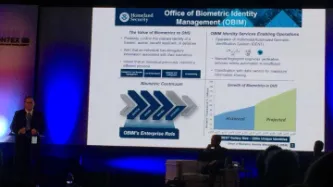
The United States Department of Homeland Security (DHS) has contracted one of the world’s largest arms companies to manage a huge expansion of its biometric surveillance programme.
According to a presentation seen by Privacy International, the new system, known as Homeland Advanced Recognition Technology (HART), will scoop up a whopping 180 million new biometric transactions per year by 2022.
It will replace the Automated Biometric Identification System (IDENT), which currently stores…

Content type: News & Analysis
Humanitarian agencies are collecting personal information for Syrians caught in the crossfire of a drawn-out and bloody civil war. Indeed, refugees fleeing persecution and conflict, need to access services and protection offered by the world’s humanitarian community. But in the rush to provide necessary aid to those afflicted by the crisis in Syria, humanitarian organisations are overlooking a human right that also needs protecting: the right to privacy.
Humanitarian and aid agencies are…

Content type: News & Analysis
Privacy International today is proud to announce our new project, Aiding Privacy, which aims to promote the right to privacy and data protection in the development and humanitarian fields. Below is an outline of the issues addressed in our new report released today, Aiding Surveillance.
New technologies hold great potential for the developing world. The problem, however, is that there has been a systematic failure to critically contemplate the potential ill effects of deploying technologies in…

Content type: News & Analysis
Few understand why we focus on refugee privacy. Funders don’t understand it so don’t fund it; the public see the plight of refugees as seen on TV, not as a privacy issue; and often times the international community does everything it can to increase scrutiny of refugees. In this blog, I highlight the privacy issues facing refugees and how these issues can jeopardize refugees’ safety as much as any of the environmental, social, or political risks refugees encounter.
Refugees are amongst…

Content type: News & Analysis
Privacy International's recent complaint to the UK Information Commissioner has threatened to bring to a halt an imminent plan to fingerprint all domestic and international passengers departing from Heathrow's Terminal 1 and Terminal 5, due to begin on March 27th. The British media is reporting that in response to PI's complaint, the Information Commissioner has advised that passengers should only accept fingerprinting "under protest" until our complaint is resolved.
The prospect of…

Content type: News & Analysis
Together with a coalition with 18 Japanese rights groups, Privacy International today delivered a letter to the Japanese Minister of Justice to protest against the implementation of a fingerprinting system and face-scanning system at its borders. All visitors and many foreign residents to Japan will be fingerprinted under this plan. Our letter to the Minister is endorsed by 68 organisations from 30 countries. In our letter, we show that there are numerous problems with the government's plans.…