Dual-use tech: the Lockheed Martin example
This company profile put together in collaboration with Corporate Watch explores an example of militarisation of tech: a convergence of corporate interests and state power, that inevitably blurs what should be very clear boundaries between civil and military domains.
Key findings
- A brief overview of the company, including its areas of operation and notable facts.
- An outline of products or technologies developed by the company that serve both civilian and military or security-related purposes, highlighting their applications and relevance across sectors.
- A summary of strategic collaborations or alliances with other firms or co-development initiatives that enhance the company’s capabilities or market reach.
- Identification of notable issues or controversies associated with the company.
- Introduction to individuals or leadership team and ownership behind the company.
Report
Post date
29th April 2026
Lockheed Martin Corporation is the world’s largest arms dealer, generating nearly 10% of the revenues of the top 100 global defence companies combined. The business was formed from the 1995 merger of Lockheed Corporation and Martin Marietta, both of which had roots in the early aviation industry and quickly realised that greater profits could be tapped from the military sector. By 2024, Lockheed Martin reported operating 350 facilities in more than 50 countries, and claimed net sales of $71bn. The US is its biggest market by far: of those sales, 73% were made to the US Government, including 65% to the Department of Defense (DoD). Only 26% of Lockheed’s contracts were struck outside the US.
Lockheed Martin is built around four core business areas: aeronautics, space, rotary and missions systems (helicopters and smart battlefield software), and missiles and fire control. Perhaps unsurprisingly given the scale of its US defence contracts, the company focuses largely on military markets. One of the company’s most infamous products is the F-35 fighter jet, which made up 26% of its net sales in 2024. However, it also markets a number of dual-use products, including observation satellites, radar, drones, and autonomously-piloted helicopters which have been used across firefighting, weather forecasting, border surveillance, and policing.
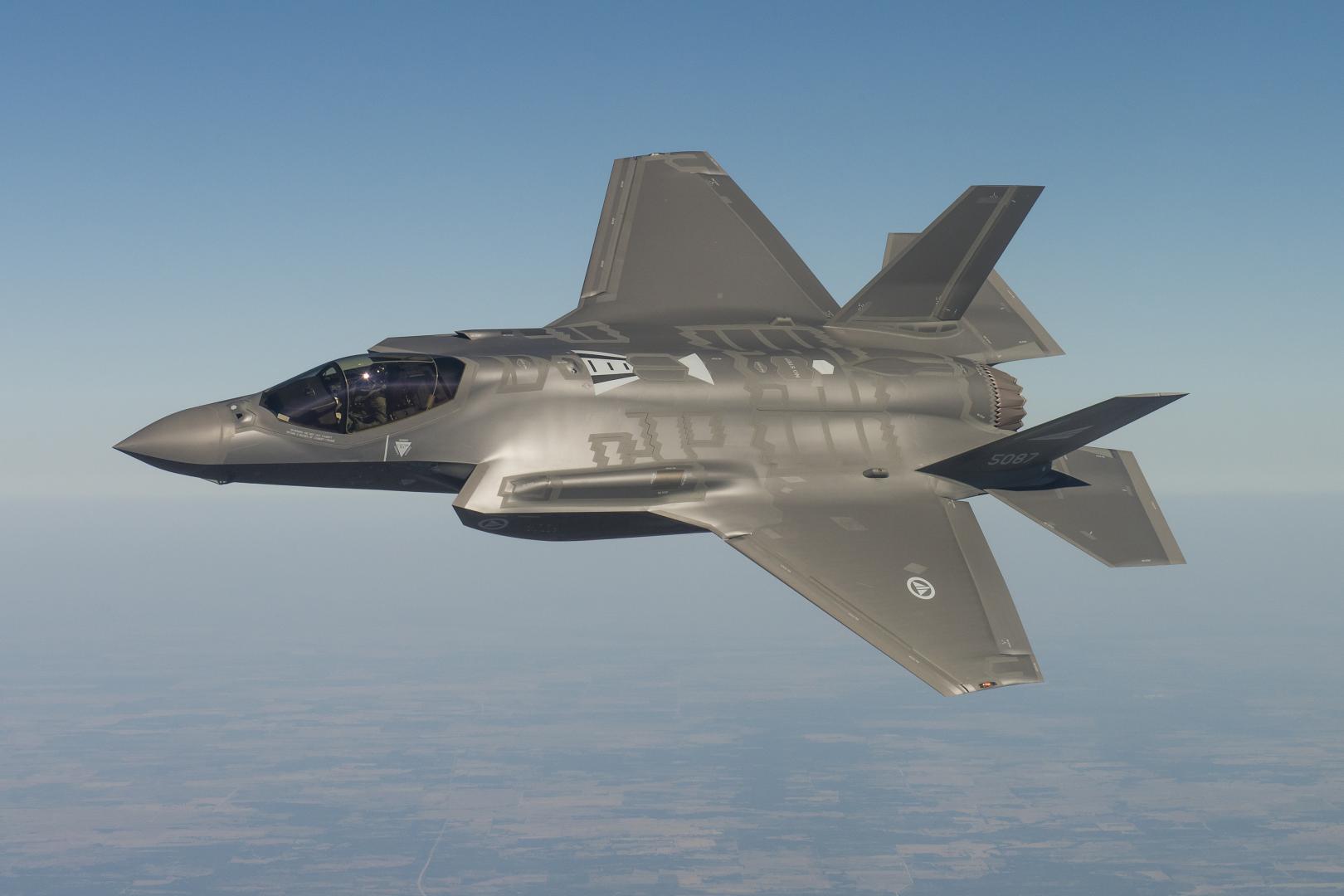
Images from a test flight of Norway’s first F-35 taken on 15 October 2015. Photo: Kaszynzki, Lockheed Martin. Source: Wikimedia
The company develops what it describes as “revolutionary technologies” across all four business areas through its specialised research and development unit, Skunk Works. Operational since the 1940s, Skunk Works’ tech now comprises drones, hypersonic missiles, and artificial intelligence (AI).
Dual-use products
Lockheed Martin has teamed up with AI giant NVIDIA since 2021 to use predictive modelling through the creation of an AI-driven ‘digital twin’ - a simulation of a physical object or system using continual data inputs - in this case, to analyse live weather data and model weather conditions for the National Oceanic and Atmospheric Administration. In 2024, the company boasted that the technology had successfully detected sea surface temperature anomalies through combining satellite data with simulation models. This is a continuation of previous work with US federal government Department of Agriculture Forest Services and the Colorado state government Division of Fire Prevention and Control, where Lockheed Martin developed a ‘Cognitive Mission Manager’ using NVIDIA’s Omniverse technology to predict wildfire paths and impacts using a simulation of wildfire incidents and data from satellites, aircrafts and on-the-ground assets. The use of modelling and simulation software, built together with NVIDIA, is also geared towards military users for planning missions, training exercises, and data analysis. This includes a planned “AI Fight Club” event for spring 2026, which will see Lockheed Martin use digital twins to competitively test how its own and other companies’ AI combat systems perform, and assess whether they meet US Department of War standards.
Another Lockheed Martin product with dual-use applications is the Black Hawk helicopter. Produced by Sikorsky, a wholly-owned Lockheed Martin subsidiary, it is marketed as a versatile helicopter for military and civilian use, and has been sold to 36 countries worldwide. The US Army, Navy, Air Force, Coast Guard, and Customs and Border Protection have used the UH-60M Black Hawk, described as a “combat-proven workhorse” for decades. There are reports of the helicopter being used during the US invasions of Grenada, Panama, Iraq, and Afghanistan as well as for disaster relief and humanitarian aid, US search and rescue missions, and border control. Beyond the US, S-70 Black Hawk helicopters have been purchased using EU RescEU funds by Romania for emergency and firefighting services. Black Hawks have also been used by the Polish National Police for police and counter-terrorism activities since 2019, and by the Canadian Mounted Police for border surveillance patrols since 2025.
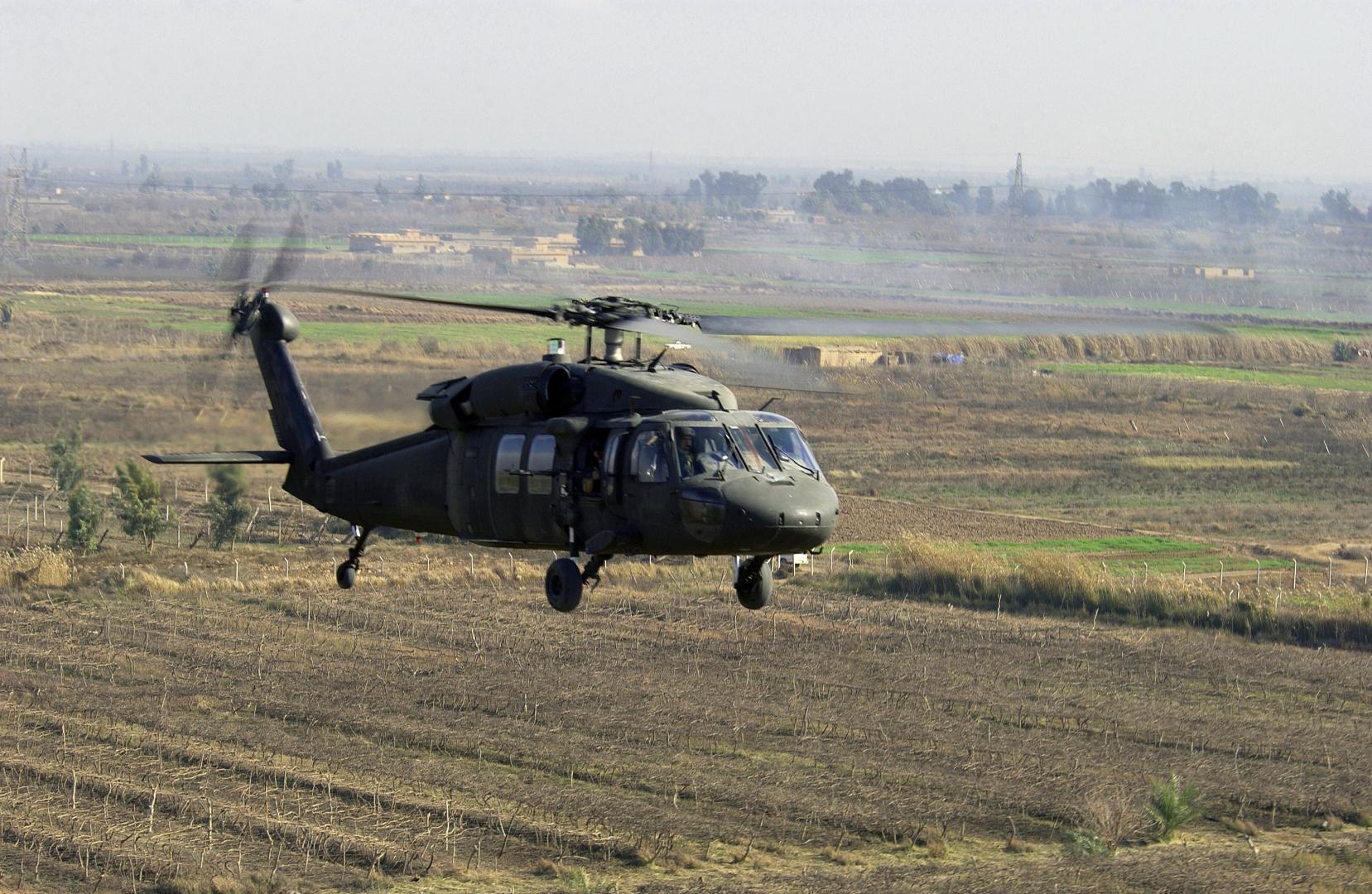
A US Army UH-60L Blackhawk Helicopter flies a low-level mission over Iraq during Operation IRAQI FREEDOM (2004). Photo: SSGT Suzanne M. Jenkins, USAF. Source: National Archives Catalog
Back in the 1990s, the California Department of Forestry and Fire Protection (CAL FIRE) asked Lockheed Martin to develop a specialised fire-safety helicopter, resulting in the FIREHAWK - a variant of the S-70 Black Hawk Helicopter (itself the commercial version of the US Army’s UH-60 Black Hawk).
More recently, Lockheed Martin, through Sikorsky, has been developing the autonomous capabilities of its helicopters. Alongside the Defence Advanced Research Projects Agency (DARPA), it has developed the MATRIX system which enables aircraft to be flown with or without a pilot. In April 2025, Black Hawk helicopters fitted with this system were used in a wildfire suppression test, with firefighters present to become “familiarized” with the technology’s potential. Just a few months later, CAL FIRE announced a 4-year collaboration to develop and deploy the “autonomy-enabled” S-70i FIREHAWK.
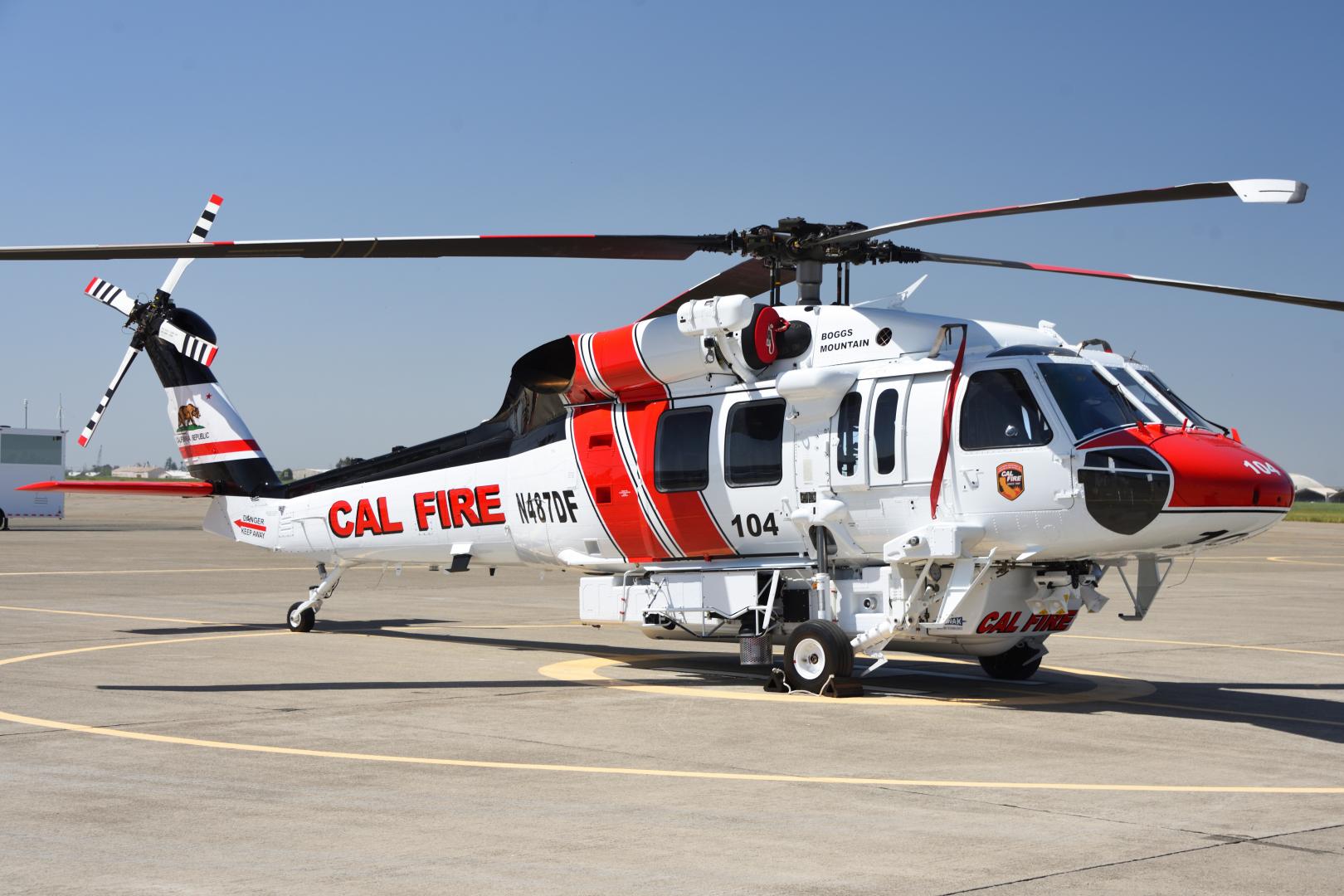
CAL FIRE Sikorsky S-70i FIREHAWK N487DF, 104. Photo: Ian Abbott. Source: Flickr
Not to be outdone, in August 2025 the US Army entered into a contract with Lockheed Martin to modernise its Black Hawk helicopters “to allow for rapid unmanned aerial systems (UAS) integration”. The result seems to be the S70 UAS U-HAWK - an autonomous, MATRIX-loaded helicopter designed for military use. With less space required for the cockpit, the U-Hawk can apparently carry rocket launchers and even unmanned ground vehicles.
Lockheed Martin provides a number of drones that have been employed by both the military and police, namely the Indago 4 Tactical Quadcopter and the Stalker Unmanned Aerial System. The Indago drone can fit in a soldier’s backpack and be quickly unfolded for deployment. Marketed for reconnaissance and surveillance, it is equipped with AI and machine learning (ML) technologies, with payloads including 30x optical zoom, and infrared cameras providing object tracking and real-time geolocation. The Royal Canadian Mounted Police have reportedly used the Indago for search and rescue missions as well as for forensics and other police procedures, including reconstructions of traffic accidents, while in 2023 the Indago 4 system was sold to an unnamed “NATO Ministry of Defense (MOD) customer”.
The Stalker VXE30 is made in partnership with the drone company Edge Autonomy (a subsidiary of the large American defence-tech company, Redwire), and is marketed as an endurance drone. It has vertical take-off and landing capabilities, infrared and low-light cameras, and is able to lock and track targets. In January 2026, the Baton Rouge police force in Louisiana US announced that it will begin using the Stalker for surveillance operations, according to EFF, having spent roughly $1m on the purchase and training in its use. Both drones have been sold to the UK Ministry of Defence in a contract worth £129m, as part of its TIQUILA programme - an intelligence, surveillance, target acquisition, and reconnaissance (ISTAR) partnership with Lockheed Martin’s Skunk Works.
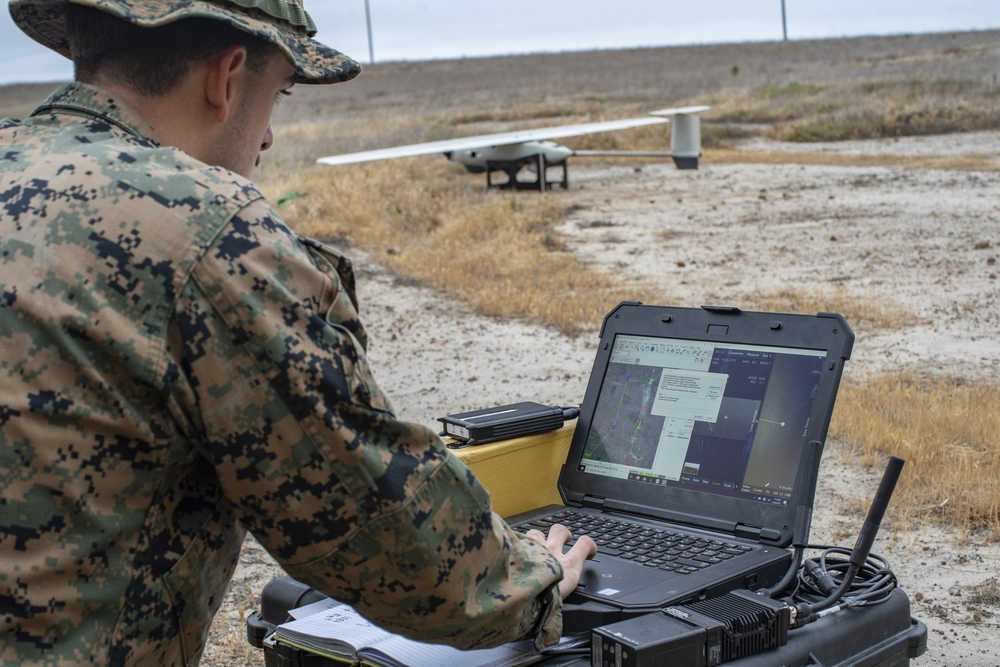
Operator conducts preflight checks on a Stalker XE UAS at San Clemente Island, California, May 18, 2021. Photo: Cpl. Seth Rosenberg. Source: DVIDS - Defense Visual Information Distribution Service
Lockheed Martin plays a major role in border security technology and has sold dual-use products - including radar systems, aerostats and drones - for use in border control in Europe, the US, and Australia. Between 2005-2019, the company received over $1bn from 20 contracts with the US Customs and Border Protection Agency (CBP), including for extensive data processing technology. In 2025, it was announced that Lockheed Martin’s AN/TPQ-53 multi-mission radar - used widely across military operations since 2010 - had been incorporated into the US Joint Task Force-Southern Border’s command and control systems for surveillance of the US-Mexico border. This follows a test exercise with Lockheed Martin and Anduril as part of the Desert Guardian initiative to strengthen the military’s drone detection abilities. The exercise integrated the Q-53 radar with Anduril’s Lattice command and control technology, which is used extensively across the US-Mexico border.
Lockheed Martin has also been involved in border surveillance through its ‘Lighter Than Air’ technology, which includes both the 420k Aerostat System and the smaller 74K Aerostat (part of its Persistent Threat Detection System). These are helium aircrafts, similar to blimps, which are loaded with surveillance radars (the 74K system also includes infrared and electro-optical cameras). The 420k Aerostat forms the standard choice for the US Southern Border Tethered Aerostat Radar System (TARS), a system set up by the US Air Force in the late 1970s to target drug smuggling, and later transferred to US Customs and Border Protection. The Persistent Threat Detection System was recently tested by the CPB for use in border security. The trial was apparently successful, since the tactical aerostat “extends the Border Patrol’s eyes and ears with these sensor and surveillance systems operating at altitude”, according to CBP. Lockheed Martin’s aerostats have also been deployed in Afghanistan and Iraq since 2003. In 2017, the US government donated a tethered aerostat radar system (TARS) to the Philippine Navy for intelligence, surveillance and reconnaissance (ISR) military missions, as well as humanitarian assistance and disaster response operations.
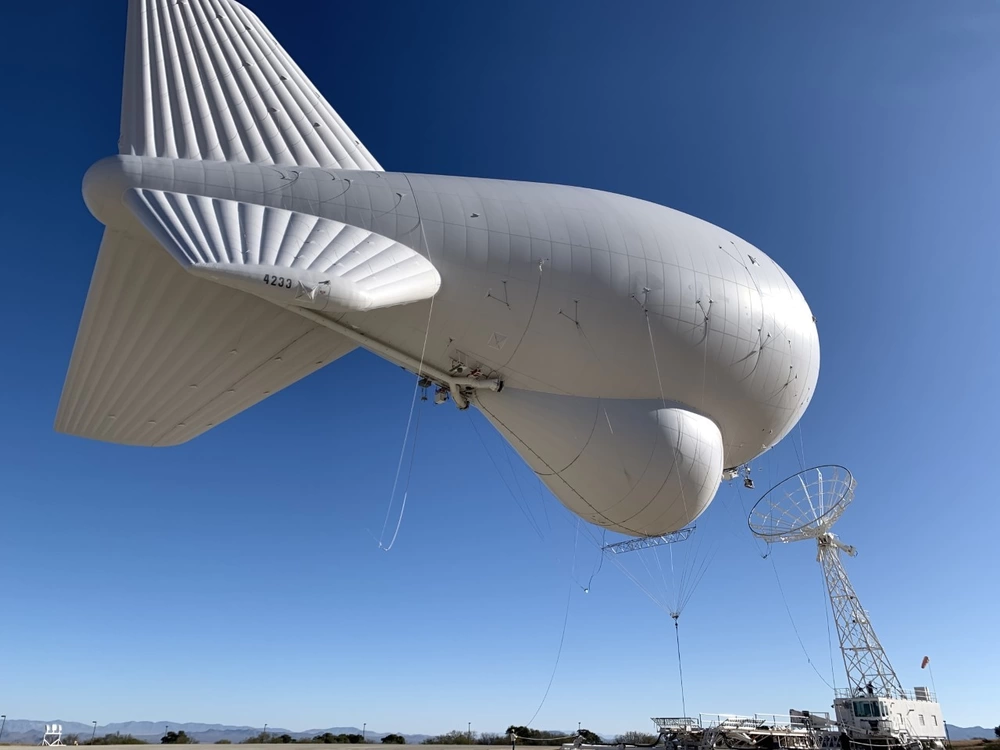
Tethered Aerostat Radar System (TARS) utilised by Department of Homeland Security and Customs and Border Protection provide radar detection and monitoring of low-altitude aircraft and surface vessels. Source: DVIDS
In 2025, it was reported that the US DoD had deployed Lockheed’s U-2, nicknamed the Dragon Lady, on surveillance missions along the US-Mexico border. The U-2 is a military surveillance aircraft that has been used since the 1950s by the US Air Force and the Central Intelligence Agency (CIA), and gained infamy for gathering covert intelligence during the Cold War. More recently it was reportedly used in the US-led wars on Iraq and Afghanistan as well as for “scientific research, communications and satellite calibration”. It is designed to fly at high altitudes and has been updated with new technologies which provide enhanced surveillance and communications capabilities, including a new mission computer, and electro-optical reconnaissance sensors. However, it seems that despite these efforts to modernise the U-2, it is set for retirement in 2026 as the US Air Force seeks to “transition to space-based and unmanned systems”.
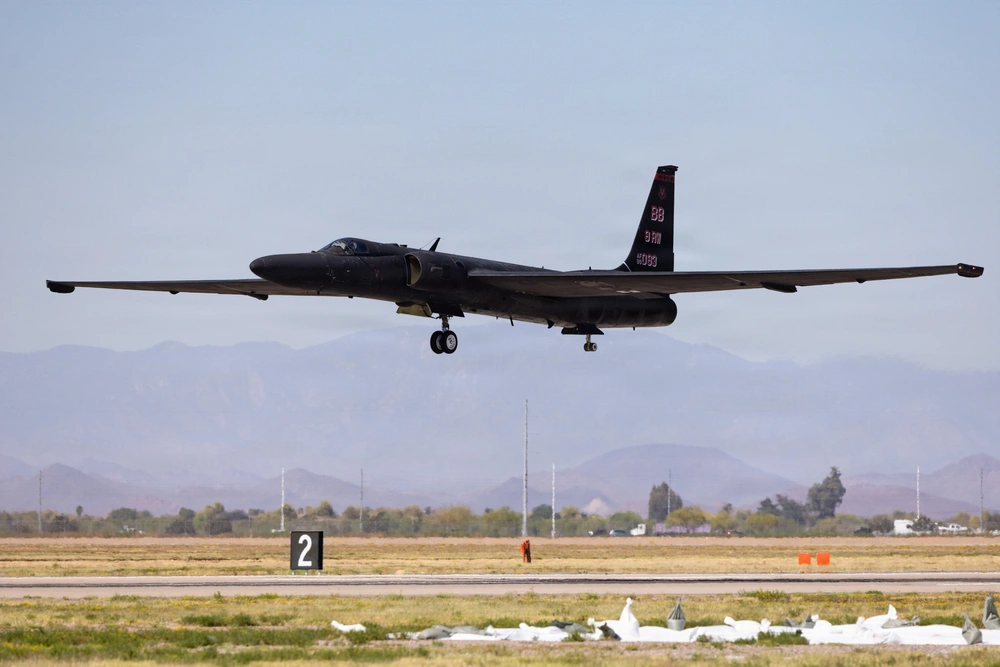
U-2 Dragon Lady. Photo: Tech. Sgt. Hampton Stramler Source: DVIDS - Defense Visual Information Distribution Service
Besides being a major aircraft manufacturer, Lockheed Martin is also one of the world’s most prominent space and satellite companies, and these products also have several dual-use applications. For decades, Lockheed Martin has played a key role in developing and modernising GPS and weather satellite technology, both of which are now in widespread military and civilian use. For instance, the company’s GPS IIR series has been used globally since 1997 for purposes including air traffic control, “precision weapon guidance” for the military, and geolocation services to internet users. Similarly, Lockheed Martin has been designing, building and launching spacecraft to monitor the weather and environmental conditions for the US military and government agencies for more than 50 years.
Partnerships & programmes
In its 2025 annual report, Lockheed Martin stated that the success of the company depends partly upon its ability to invest in emerging technologies and to operate within commercial markets. One way in which the company has done this is through Lockheed Martin ventures (LVM) - a $400m evergreen venture capital fund that is “looking for what we call ‘dual use’ technologies” to invest in. Since it was created in 2007, it has provided funds to over 120 companies. These consist of a carefully compiled list that aligns with Lockheed Martin’s business interests and anticipated future challenges.
Notable companies that have received funding from LVM include Skydio, the notorious tech start-up that rapidly became a leading dual-use drone manufacturer, which we profiled as part of this series. LVM has also funded Firestorm Labs - which secured a $100m contract with the US Air Force in 2025 to develop 3D printed drones - and Fortem Technologies, whose drone hunters have been bought for the US DoD’s Replicator programme.
Lockheed’s innovation programme, LM Evolve, was launched in 2022 to “identify, accelerate, and scale transformative technologies” and “fast-track” dual-use technologies “to meet urgent customer needs and global security challenges”. One of its portfolio companies is Astris AI, a new subsidiary which provides AI infrastructure for use across US defence and commercial industries. Among the first to adopt the Astris AI platform was XBow Systems - another LVM start-up - which makes solid rocket motors for missiles and rockets with military and commercial uses.
In December 2025, Astris AI launched Astris AI for Government, which offers secure machine learning and generative AI platforms (developed in-house alongside Meta, Oracle and NVIDIA) that facilitates the large-scale deployment of AI applications.
Other critical issues
In 2024, Lockheed Martin was called on by UN experts to end transfers of dual-use technology to Israel, even if they are executed under existing export licenses. In 2025 the UN Special Rapporteur on human rights in the occupied Palestinian territories released a report on the firms complicit in the genocide, listing Lockheed Martin and its products as having enhanced Israel’s capacity to perpetuate apartheid, being integral to equipping Israel to kill and injure Palestinians and to obliterate Gaza, and testing its surveillance technology on Palestinians. Industrial collaborations between Lockheed Martin and Israel have existed for over 20 years, including the signing of an “Industrial Participation” agreement for the F-35 program expected to be worth over $6bn by its completion. Part of the agreement involves the transfer of technology and local investment in Israel. Notably, this includes significant investment in STEM kindergartens in Israel. The first MadaKids Lockheed Martin technology kindergartens was launched in 2015, and the company also funds initiatives across middle school (girls-only STEM summer camps), as well as SkillZ, a cyber competition in Israeli high schools.
Lockheed was also involved in corruption scandals through the 1950s-1970s in Japan, Saudi Arabia, and the Netherlands; bribery scandals in Egypt in the 1980s; and large-scale tax avoidance dating back to the 1960s. There are 106 recorded violations of the company for government contracting, pricing, fulfilment, employment, competition, environment and safety related offences, with a total of $334m paid in penalties since 2000. Since 2025, the company has been facing a lawsuit that alleges it provided false or misleading statements leading to substantial financial losses to investors, including overstating its ability to meet its commitments.
People & politics
Lockheed Martin conducts extensive lobbying practices. In 2025 the company spent over $15.5m on lobbying in the US, and has spent over $80m on lobbying across issues including defence, federal budget, aerospace, foreign relations and Homeland Security since 2020. The company has also lobbied on the 2025 One Big Beautiful Bill Act and National Defense Authorisation Act, both of which set out huge amounts of funding for defence, space, border control and AI technology.
Further demonstrating attempts to gain political influence over defence policy and spending, the company also contributes to some of the top military and defence think tanks in the US, including the Atlantic Council, the Center for a New American Security and the Center for Strategic and International Studies.
Lockheed Martin, like many other arms companies, operates a fast revolving door with the US government: in 2022 it was reported that 49 out of 70 of the company’s US lobbyists had previously been employed in government jobs. Employees at the company also make contributions to US federal and state politicians through its Political Action Committee.
The Chairman, President and Chief Executive Officer of Lockheed Martin is Jim Taiclet who joined the company’s board of directors in 2018. In 2025, Taiclet was accused of insider trading, allegedly gaining $12.8m in stock sales shortly before a price drop in shares due to the company’s failure to fulfil government contracts. In 2024, it was reported that Taiclet took home $23.8m in ‘compensation’ including salary, bonuses, and stock awards.
Who’s behind the brand?
According to financial databases, by December 2025, Lockheed Martin’s top shareholders include State Street Global Advisors Inc (~15%), the Vanguard Group Inc (~9%); Blackrock Inc (~7%); Charles Schwab Investment Management (~4%); and Geode Capital Management LLC (~2%).
Appendix: additional examples of dual-use technology
- iSpace is command and control and traffic detection software, which uses data from government and commercial space hardware to provide real-time information to governmental, civilian and commercial customers to detect ‘space events’, including debris and collisions. It has been used by the US National Space Defense Centre to integrate data across government and commercial sensors, and for ‘Space Domain Awareness’ for US allies, such as Germany.
- ARISE is software which is used to create its digital twin simulations and use AI and ML data analytics to detect errors and anomalies in new technologies and digital systems.
- Lockheed Martin proclaims Minerva to be “engineering the future of mail” with its suite of AI technology for mail sorting tasks, reportedly used in the UK and across Europe. The software sorts mail, and analyses data on post items, including customs information and labels.
- Nomad is a new vertical take-off and landing long-range drone, using MATRIX technology to assist with autonomous flying. Produced via Lockheed’s subsidiary Sikorsky, it is marketed as able to assist with missions across land and sea, including defence and security missions, as well as civilian operations. The company announced it will be releasing a “family” of Nomads in October 2025, including smaller drones, and large aircraft the size of Black Hawk helicopters.
- Guided by the US Department of Defence goals for a “Combined Joint All-Domain Command and Control” system, Lockheed Martin also focuses on enabling comprehensive communication and data sharing through its ‘5G.MIL Unified Network Solutions’. This is an advanced, space-based 5G “network of networks” that seeks to provide secure communication of information across all domains globally through integrating commercial 5G technology with military systems. The system includes commercial technologies from Intel, Microsoft and Nokia. In 2023, Lockheed Martin announced that it was preparing to launch the first 5G.MIL payload satellite, although there are no confirmed reports that this has taken place.
Target Profile
Our campaign