
Search
Content type: Long Read
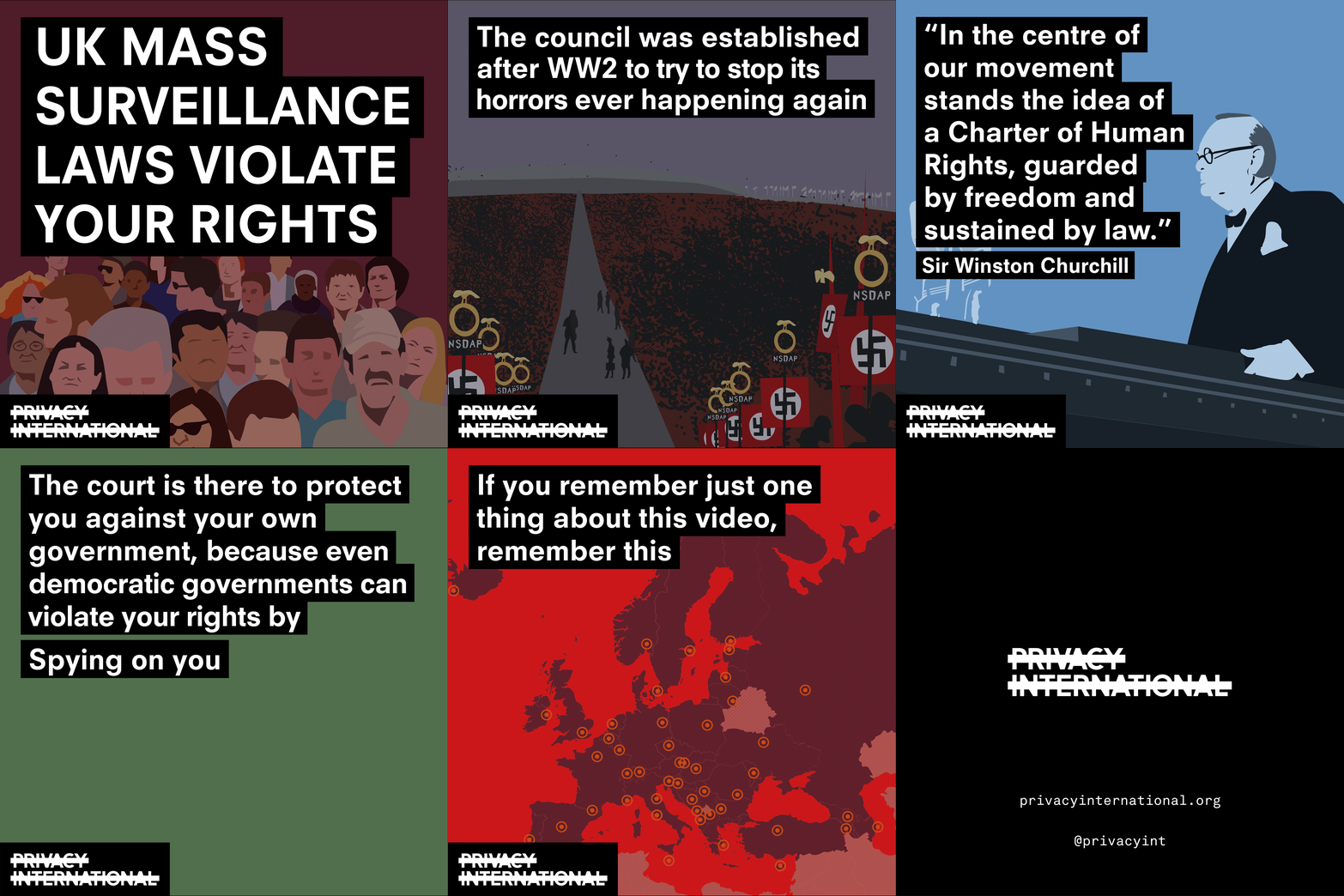
Yesterday, the European Court of Human Rights issued its judgement in Big Brother Watch & Others V. the UK. Below, we answer some of the main questions relating to the case.
What's the ruling all about?
In a nutshell, one of the world's most important courts, the European Court of Human Rights, yesterday found that certain UK laws about how intelligence agencies can spy on our internet communications breach our human rights. These surveillance laws have meant that the UK intelligence…

Content type: News & Analysis
This post was written by William Marks, a former volunteer at Privacy International.
The right to privacy is central to the protection of human dignity, and supports and reinforces other rights, such as the right to freedom of expression and association. Privacy International, supported by the International Human Rights Clinic at Harvard Law School, recently submitted a joint stakeholder report to the United Nations Human Rights Council regarding New Zealand’s protection of the right to…

Content type: News & Analysis
Our intervention comes on the back of mounting evidence that the South African state’s surveillance powers have been abused, and so-called “checks & balances” in RICA have failed to protect citizens’ constitutional right to privacy.
Among our core arguments are:
That people have a right to be notified when their communications have been intercepted so that they can take action when they believe their privacy has been unlawfully breached. Currently RICA prevents such notification, unlike…
Content type: Press release
We found this image here
The Investigatory Powers Tribunal (IPT) today held that, for a sustained period, successive Foreign Secretaries wrongly gave GCHQ unfettered discretion to collect vast quantities of personal customer information from telecommunications companies.
The judgment exposes:
· the error-ridden and inconsistent evidence provided by GCHQ throughout the case;
· the willingness of telecommunications companies to secretly hand over customer data on the basis of mere verbal…

Content type: Impact Case Study
PI and our global partners have been at the forefront of challenging communications data retention for over a decade.
What is the problem
Communications data, also known as metadata, tells a story about your digital activity and answers the who, when, what, and how of a specific communication. While communications data doesn't include the contents of a message, all of the other information about the message can be very revealing about people, their habits, thoughts, health and personal…

Content type: Impact Case Study
What is the problem
For over two decades we have been documenting an alarming use and spread of surveillance. It is no longer just the wars on terror or drugs or migration that is driving this trend. The management of health crises and distribution of welfare regularly are among others being used to justify this turn to increasingly invasive forms of surveillance. From country to country we see the same ideas and the same profiteers expanding their reach.
When we first released our report on…

Content type: Advocacy
A new Privacy International report based on an international collaborative investigation carried out by 40 NGOs in 42 countries has found alarming weaknesses in the oversight arrangements that are supposed to govern the sharing of intelligence between state intelligence agencies, including in the UK. Privacy International urges governments to enact urgent reforms and improve public understanding about the scope of intelligence sharing and the safeguards and oversight currently in place.
Content type: Long Read
A major new report published today by Privacy International has identified alarming weaknesses in the oversight arrangements that are supposed to govern the sharing of intelligence between state intelligence agencies.
'Secret Global Surveillance Networks: Intelligence Sharing Between Governments and the Need for Safeguards' is based on an international collaborative investigation carried out by 40 NGOs in 42 countries.
Previously undisclosed documents obtained by PI via litigation in the…
Content type: Press release
Below is a joint statement from Privacy International and Bytes for All.
This Friday, 27 September, marks the conclusion of the 24th session of the UN Human Rights Council, a session which has, for the first time, seen issues of internet surveillance in the spotlight. Privacy International and Bytes for All welcome the attention given at the Human Rights Council to this issue. However, we are concerned about developments which took place that threaten privacy rights and freedom of…

Content type: News & Analysis
15 October 2014
The following was written by Carly Nyst, Legal Director for Privacy International, and originally appeared in the Guardian's Comment is Free section:
Until the fall of the Berlin wall in 1989, the East German state security service – the Stasi – conducted surveillance and kept files on a third of the country’s population. One of those people was activist and dissident Ulrike Poppe, whose communications and activities were spied on by Stasi operatives constantly for 15 years.…

Content type: Long Read
Privacy International is celebrating Data Privacy Week, where we’ll be talking about privacy and issues related to control, data protection, surveillance and identity. Join the conversation on Twitter using #dataprivacyweek.
Exercising the right to privacy extends to the ability of accessing and controlling our data and information, the way it is being handled, by whom, and for what purpose. This right is particularly important when it comes to control of how States perform these activities.…