
Search

Content type: News & Analysis
On 24 October 2019, the Swedish government submitted a new draft proposal to give its law enforcement broad hacking powers. On 18 November 2019, the Legal Council (“Lagråd”), an advisory body assessing the constitutionality of laws, approved the draft proposal.
Privacy International believes that even where governments conduct hacking in connection with legitimate activities, such as gathering evidence in a criminal investigation, they may struggle to demonstrate that hacking as…

Content type: Advocacy
As any data protection lawyer and privacy activist will attest, there’s nothing like a well-designed and enforced data protection law to keep the totalitarian tendencies of modern Big Brother in check.
While the EU’s data protection rules aren’t perfect, they at least provide some limits over how far EU bodies, governments and corporations can go when they decide to spy on people.
This is something the bloc’s border control agency, Frontex, learned recently after coming up with a plan to…

Content type: Long Read
This research is the result of a collaboration between Grace Tillyard, a doctoral researcher in the Media, Communications and Cultural Studies department at Goldsmiths College, London, and Privacy International.
Social Protection Systems in the Digital Age
In the digital age, governments across the world are building technologically integrated programmes to allow citizens to access welfare payments. While smart and digital technologies hold the potential to streamline administrative…
Content type: News & Analysis
Photo: The European Union
“Border Externalisation”, the transfer of border controls to foreign countries, has in the last few years become the main instrument through which the European Union seeks to stop migratory flows to Europe. Similar to the strategy being implemented under Trump’s administration, it relies on utilising modern technology, training, and equipping authorities in third countries to export the border far beyond its shores.
It is enabled by the adoption…

Content type: News & Analysis
Photo by Francesco Bellina
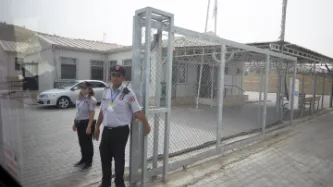
The wars on terror and migration have seen international funders sponsoring numerous border control missions across the Sahel region of Africa. Many of these rely on funds supposed to be reserved for development aid and lack vital transparency safeguards. In the first of a series, freelance journalist Giacomo Zandonini sets the scene from Niger.
Surrounded by a straw-yellow stretch of sand, the immense base of the border control mobile company of Maradi, in southern…

Content type: News & Analysis
Photo by Sharon McCutcheon on Unsplash
In May, the United Nations Special Rapporteur on extreme poverty and human rights, Philip Alston invited all interested governments, civil society organisations, academics, international organisations, activists, corporations and others, to provide written input for his thematic report on the human rights impacts, especially on those living in poverty, of the introduction of digital technologies in the implementation of national social protection…

Content type: News & Analysis
Photo: The European Union
On 2 September 2019, Privacy International, together with 60 other organisations, signed an open letter to the European Parliament to express our deep concern about upcoming EU policy proposals which undermine the EU’s founding values of human rights, peace and disarmament.
Since 2017, the EU has diverted funds towards security research and security capacity-building in countries around the world. The proposal for the EU's next budget (2021-2027) will…
Content type: Examples
The US Department of Homeland Security awarded a $113 million contract to General Dynamics to carry out the Visa Lifecycle Vetting Initiative (VLVI), a renamed version of the Extreme Vetting Initiative and part of a larger effort called the National Vetting Enterprise. In May 2018, public outrage led the DHS to back away from a machine learning system that would monitor immigrants continuously; however, the reason it gave was that the technology to automate vetting did not yet exist. These…

Content type: Examples
In 2017, US Immigration & Customs Enforcement (ICE) announced that it would seek to use artificial intelligence to automatically evaluate the probability of a prospective immigrant “becoming a positively contributing member of society.” In a letter to acting Department of Homeland Security Secretary Elaine Duke, a group of 54 concerned computer scientists, engineers, mathematicians, and researchers objected to ICE’s proposal and demanded that ICE abandon this approach because it would be…

Content type: Examples
The US government created a database of more than 50 journalists and immigrant rights advocates, many of whom were American citizens, associated with the journey of migrants travelling from Central America to the Mexico-US border in late 2018. Officials from Customs and Border Protection (CBP), Immigration and Customs Enforcement (ICE), the US Border Patrol, Homeland Security Investigations, and the Federal Bureau of Investigation (FBI) had access to this database. This list allowed the…

Content type: Examples
Absher, an online platform and mobile phone app created by the Saudi Arabian government, can allow men to restrict women’s ability to travel, live in Saudi Arabia, or access government services. This app, which is available in the Google and Apple app stores, supports and enables the discriminatory male guardianship system in Saudi Arabia and violations of womens’ rights, including the right to leave and return to one’s own country. Because women in Saudi Arabia are required to have a male…

Content type: News & Analysis
US Immigration and Customs Enforcement (ICE), the agency at the centre of carrying out President Trump’s “zero tolerance” approach to immigration enforcement and family separation, has for years been contracting a US surveillance company to intercept peoples’ communications across the United States. The wide potential scope for the use of the powers raises concerns about their use for the real-time surveillance of people, families, and communities caught up in Trump’s immigration crackdown…

Content type: News & Analysis
According to the International Organization for Migration, an estimated 258 million people are international migrants – that is, someone who changes their country of usual residence, That’s one in every 30 people on earth.
These unprecedented movements levels show no sign of slowing down. It is predicted that by 2050, there will be 450 million migrants across the world.
Nowadays, it is politically acceptable to demonise migrants, and countless leaders have spewed divisive and xenophobic…