
Search
Content type: News & Analysis
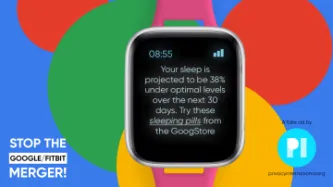
Today, the European Commission has concluded its Phase II in-depth review of the proposed acquisition of the health and fitness tracker Fitbit by Google, deciding that the merger can go through. While we welcome the commitments put forward by Google to mitigate some risks of compromising individuals' rights and competition, PI considers the effects of this merger will further strengthen Google's capacity to exploit our data.
On 15 June 2020, Google formally notified the European Commission of…
Content type: Long Read
An edited version of this article was originally published on the EDRi website in September 2020.
Introduction
Monopolies, mergers and acquisitions, anti-trust laws. These may seem like tangential or irrelevant issues for privacy and digital rights organisations. But having run our first public petition opposing a big tech merger, we wanted to set out why we think this is an important frontier for people's rights across Europe and indeed across the world.
In June, Google notified the…

Content type: Explainer
At first glance, infrared temperature checks would appear to provide much-needed reassurance for people concerned about their own health, as well as that of loved ones and colleagues, as the lockdown is lifted. More people are beginning to travel, and are re-entering offices, airports, and other contained public and private spaces. Thermal imaging cameras are presented as an effective way to detect if someone has one of the symptoms of the coronavirus - a temperature.
However, there is little…

Content type: Explainer
Definition
An immunity passport (also known as a 'risk-free certificate' or 'immunity certificate') is a credential given to a person who is assumed to be immune from COVID-19 and so protected against re-infection. This 'passport' would give them rights and privileges that other members of the community do not have such as to work or travel.
For Covid-19 this requires a process through which people are reliably tested for immunity and there is a secure process of issuing a document or other…
Content type: Press release
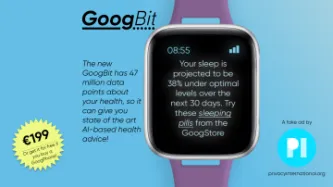
On 15 June 2020, Google formally notified the European Commission of its proposed acquisition of Fitbit, enabling them to capture a massive trove of sensitive health data that will expand and entrench its digital dominance. Privacy International is calling on EU regulators to block the merger.
In November 2019, Google announced its plan to acquire Fitbit, a company that produces and sells health tracking technologies and wearables - including smartwatches, health trackers and smart scales -…
Content type: Long Read
This week saw the release of a coronavirus tracking app within the United Kingdom, initially to be trialled in the Isle of Wight. Privacy International has been following this closely, along with other ‘track and trace’ apps like those seen in over 30 other countries.
The UK’s app is no different. It is a small part of a public health response to this pandemic. As with all the other apps, it is vital that it be integrated with a comprehensive healthcare response, prioritise people, and…

Content type: Long Read
UPDATE 21/07/2020: On Monday July 20th, the Israeli parliament approved a new bill allowing the Ministry of Health to rely again on the Intelligence Services to track people who may have been exposed to Covid 19 when the number of new cases reaches 200 and above per day. The authorisation is then granted for three weeks and can be extended if the numbers have not decreased. The new law will be effective until January 2021. As of July 21st and for at least the next three weeks, the Intelligence…

Content type: News & Analysis
This week International Health Day was marked amidst a global pandemic which has impacted every region in the world. And it gives us a chance to reflect on how tech companies, governments, and international agencies are responding to Covid-19 through the use of data and tech.
All of them have been announcing measures to help contain or respond to the spread of the virus; but too many allow for unprecedented levels of data exploitation with unclear benefits, and raising so many red flags…
Content type: Examples
The World Health Organization will partner with major blockchain and technology companies to launch a distributed ledger-based platform to be dubbed "MiPasa" that it says will facilitate "fully private information sharing between individuals, state authorities, and health institutions" by cross-referencing siloed location and health data to create global insights. The WHO believes the system can ensure patient privacy. MiPasa also expects to host an array of publicly accessible analytics tools…

Content type: Long Read
This piece was written by Aayush Rathi and Ambika Tandon, who are policy officers at the Centre for Internet and Society (CIS) in India. The piece was originally published on the website Economic Policy Weekly India here.
In order to bring out certain conceptual and procedural problems with health monitoring in the Indian context, this article posits health monitoring as surveillance and not merely as a “data problem.” Casting a critical feminist lens, the historicity of surveillance practices…