
Search
Content type: News & Analysis
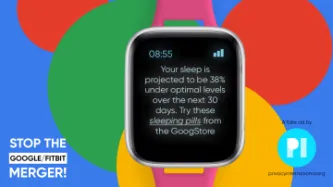
Today, the European Commission has concluded its Phase II in-depth review of the proposed acquisition of the health and fitness tracker Fitbit by Google, deciding that the merger can go through. While we welcome the commitments put forward by Google to mitigate some risks of compromising individuals' rights and competition, PI considers the effects of this merger will further strengthen Google's capacity to exploit our data.
On 15 June 2020, Google formally notified the European Commission of…

Content type: News & Analysis
Privacy International (PI) welcomes today's report from the UK Information Commissioner's Office (ICO) into three credit reference agencies (CRAs) which also operate as data brokers for direct marketing purposes. As a result, the ICO has ordered the credit reference agency Experian to make fundamental changes to how it handles people's personal data within its offline direct marketing services.
It is a long overdue enforcement action against Experian.…

Content type: News & Analysis
Back in June, we published our investigation into Facebook brands, highlighting how Facebook failed to provide its users with a fair and meaningful understanding of how targeted advertising operated on its platform, and a number of issues preventing users from exercising their rights to the fullest possible extent. In face of the serious gaps encountered, we published an open letter to Facebook drawing attention to four main issues as well as our recommended actions to tackle them. This letter…

Content type: News & Analysis
Banning TikTok? It's time to fix the out-of-control data exploitation industry - not a symptom of it
Chinese apps and tech companies have been at the forefront of the news recently. Following India's ban of 59 chinese apps in July, President Trump announced his desire to ban TikTok, shortly followed by his backing of Microsoft's intention to buy the US branch of its parent company ByteDance. Other than others lip syncing his public declaration, what does President Trump fear from this app, run by a firm, based in China?
It's all about that data
One clear answer emerges: the exploitation of…

Content type: Long Read
Introduction
In August 2019, when Facebook announced a few new features for advertisers such as ads in search, PI decided to take an in-depth look at what features the company offers its users when it comes to understanding its advertising practices. One of these features, which caught our attention is Facebook Ads Preference, a tool that among other things, lists businesses/advertisers that have uploaded your personal data to target you with (or exclude you from) ads on the platform.

Content type: News & Analysis
GDPR was hard won. PI, together with other civil society actors, fought from the beginning for a version of the law that offers the strongest rights and protections in the face of intense industry lobbying.
Holding the hidden data ecosystem to account
Two years ago, we committed to using GDPR to seek to hold to account the hidden data ecosystem - those companies that amass and exploit large amounts of our data for profit.
Here’s some of the action we’ve taken:
In Nov 2018,…

Content type: Case Study
The run up to Kenya’s 2017 elections was extremely tense. Kenya has a history of violently fought elections and there was fear this election would be no different. It was in this tense environment, that companies like Cambridge Analytica and Harris Media – and their digital offerings - got involved in the election campaigns.
Cambridge Analytica’s business model is by now familiar, they compiled a huge amount of data points, often through illegal means, to create profiles on individuals –…
Content type: Examples
An engineering and computer science professor and his team from The Ohio State University discovered a design flaw in low-powered Bluetooth devices that leaves them susceptible to hacking.
Zhiqiang Lin, associate professor of computer science and engineering at the university, found the commonly used Bluetooth Low Energy devices, such as fitness trackers and smart speakers, are vulnerable when they communicate with their associated apps on the owner’s mobile phone.
"There is a fundamental…

Content type: Long Read
In 2018, following the Cambridge Analytica scandal, Facebook announced the “Download Your Information” feature allowing users to download all the information that the company have on them since the creation of the account. All of it? It doesn’t seem so. Concerns were quickly raised when Facebook released the feature, that the information was inaccurate and incomplete.
Privacy International recently tested the feature to download all ‘Ads and Business’ related information (You can accessed it…

Content type: Case Study
In 2015, a man in Connecticut was charged with murdering his wife based on evidence from her Fitbit. Richard Dabate, the accused, told the police that a masked assailant came into the couple’s suburban home at around 9am on 23 December 2015, overpowering Dabate then shooting his wife as she returned through the garage.
However, the victim’s fitness tracker told a different story. According to data from the device, which uses a digital pedometer to track the wearer’s steps, Dabate’s wife was…

Content type: Advocacy
TEDIC, InternetLab, Derechos Digitales, Fundación Karisma, Dejusticia, Asociación por los Derechos Civiles and Privacy International welcome the call made by the Special Rapporteurship on Economic, Social, Cultural and Environmental Rights (ESCER) of the Inter-American Commission on Human Rights (IACHR) to inform the preparation of the Annual Report of the ESCER for the year 2019, which will be presented to the Organization of American States (OAS) during 2020.
This submission aims to outline…

Content type: Explainer
Television offers some of the earliest instances of digital marketing. The majority of television channels rely on commercials and advertisements to maintain their operations. For the past 75 years, TV adverts have been passive transmissions broadcast to viewers, the demographics of the channels audience guiding the kinds of products and services shown during commercial breaks and intermissions. With the changes in the way individuals are now consuming content however, broadcasters are trying…