Teacher's Guide to Facial Recognition in Schools: UK Edition
PI has produced a guide for UK teachers and students on facial recognition in schools, explaining how it works, what the law says and what to do if it appears.
The technology turns a face into a permanent biometric “faceprint” that can be stored, shared or reused, and it is already in use
Because education is compulsory, pupils and parents can rarely refuse, so consent is never freely given.
Across UK schools, education technology (EdTech) is being introduced to make teaching more efficient and more secure. But not every tool is as harmless as it looks.
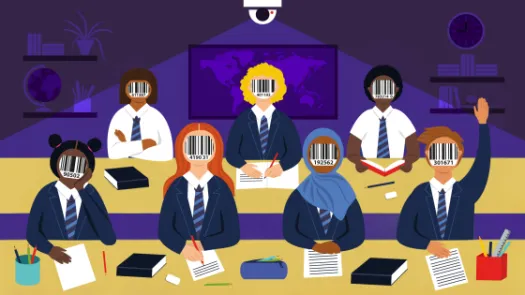
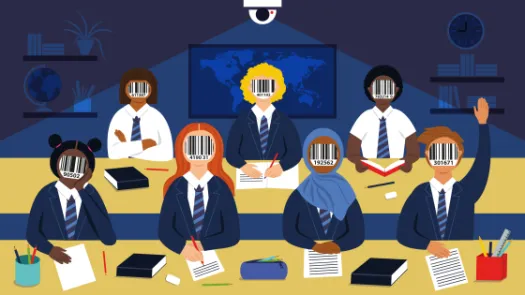
One of the most concerning developments is facial recognition technology (FRT), which identifies and tracks people by analysing their faces. It is often sold as a convenient way to take attendance, process lunch payments or monitor behaviour. In practice, it raises serious questions about privacy, consent and children’s rights.
That’s why we’ve produced a new guide for teachers and students on facial recognition in schools. It explains how the technology works, what the law says, and what you can do if it appears in your school.
Why this matters
FRT works by capturing an image of a face, converting it into a unique numerical “faceprint”, and comparing it against stored data. A faceprint is biometric data, as individual as a fingerprint. Once collected, it can be stored indefinitely, shared with third parties or reused to train other AI systems.
This is already happening. In North Ayrshire, nine secondary schools used facial recognition at canteen tills to take lunch payments. Elsewhere, the Swedish data protection authority fined a school around €20,000 for using facial recognition to track attendance, finding that consent could not be freely given given the imbalance of power between school and pupil.
For children, the problem is sharper. Education is compulsory, so pupils and parents can rarely refuse to hand over their data.

The risks the guide covers
The guide sets out why we believe facial recognition has no place in educational settings:
- Privacy: Schools already hold a great deal of sensitive information about children. Biometric data adds a new and highly intrusive layer.
- Data protection: The more organisations hold biometric data, the greater the risk it is leaked, hacked or repurposed for commercial, advertising or even immigration-control purposes.
- Trust: Constant monitoring creates an atmosphere of suspicion. It can chill free expression and damage the openness between students and teachers that learning depends on.
- Discrimination: FRT has a record of misidentifying people from minority groups and gender non-conforming people.
The UN Special Rapporteur on the right to education has recommended that states ban facial recognition from educational institutions altogether. We agree.
What the law says, and what you can do
The guide walks through the legal landscape, including the UN Convention on the Rights of the Child, the ICO’s Age Appropriate Design Code and the Data (Use and Access) Act 2025. It also asks questions about whether those protections are strong, or well enough enforced, to safeguard children from biometric surveillance.
Crucially, it gives teachers practical steps. Throughout, you’ll find short prompts to put to your data protection officer, headteacher or MP. They cover things like whether a Data Protection Impact Assessment has been carried out, where biometric data is stored, and whether pupils who opt out have a genuine alternative.
Teachers are also stronger when they act together. The guide looks at how unions and staff can push for consultation before new technology is introduced, drawing on examples of collective agreements that give staff a real say. It also sets out what policies to push for: protections for staff, prohibitions on facial recognition, mandatory DPIAs, and safeguards ensuring biometric data is never used for AI training or commercial purposes.
Teachers are on the front line of protecting pupils’ wellbeing, and that now includes their digital safety. Students, too, deserve to understand the technology being pointed at them. Whether you’re a teacher, a student or a parent, we hope this guide helps you ask the right questions and push back where you need to.
[Guide to be attached at the bottom]