
Search
Content type: Report
Over the past years, data retention regulation imposing generalised and indiscriminate data retention obligations to telecommunication companies and Internet service provides has been introduced in various jurisdictions across the world. As the data retention practices across the world have evolved this new report is an attempt to shed some light on the current state of affairs in data retention regulation across ten key jurisdictions. Privacy International has consulted with human…

Content type: Report
Privacy International’s submissions for the Independent Chief Inspector of Borders and Immigration inspection of the Home Office Satellite Tracking Service Programme
The Home Office have introduced 24/7 electronic monitoring and collection of the location data of migrants via GPS ankle tags. This seismic change cannot be overstated. The use of GPS tags and intention to use location data, kept for six years after the tag is removed, in immigration decision-making goes far beyond the mere…

Content type: Explainer
Following sustained reporting by researchers, journalists and activists around the world, including recent disclosures exposed by the PegasusProject, the surveillance industry is facing scrutiny like never before.
In the latest move, eighteen U.S. lawmakers have today demanded that the U.S. government imposes sanctions on four non-US surveillance companies for, as they mention in their letter, facilitating “disappearance, torture and murder of human rights activists and journalists”.
The move…

Content type: Explainer
An array of digital technologies are being deployed in the context of border enforcement. Satellite and aerial surveillance are part of the surveillance toolkit and yet, they are also used by organisations seeking to hold government actions to account and improve efficacy of their own work. To effectively critique state use and delve into potential benefits of satellite and aerial surveillance, we must first understand it.
In this explainer we dig into a technology which many are aware of for…

Content type: Long Read
The Grand Chamber of the European Court of Human Rights ruled that the UK government’s historical mass interception program violates the rights to privacy and freedom of expression. The Court held that the program “did not contain sufficient “end-to-end” safeguards to provide adequate and effective guarantees against arbitrariness and the risk of abuse.” As a result the Court ruled that UK law "did not meet the “quality of law” requirement and was therefore incapable of keeping the “…

Content type: Long Read
Tucked away in a discrete side street in Hungary’s capital, the European Union Agency for Law Enforcement Training (CEPOL) has since 2006 operated as an official EU agency responsible for developing, implementing, and coordinating training for law enforcement officials from across EU and non-EU countries.
Providing training to some 29,000 officials in 2018 alone, it has seen its budget rocket from €5 million in 2006 to over €9.3 million in 2019, and offers courses in everything from…

Content type: Long Read
Content type: Long Read
Q&A: EU's top court rules that UK, French and Belgian mass surveillance regimes must respect privacy

Content type: Explainer
In a scramble to track, and thereby stem the flow of new cases of Covid-19, Governments around the world are rushing to track the locations of their populace. One way to do this is to leverage the metadata held by mobile service providers (telecommunications companies - "Telcos" - such as Hutchison 3 (Also known as Three), Telefonica (Also known as O2), Vodafone, and Orange) in order to track the movements of a population, as seen in Italy, Germany and Austria, and with the European Commission…

Content type: Long Read
Commercial interests seem to often overshadow the EU’s stance as a global privacy leader. After looking at Europes's shady funds to border forces in the Sahel area, Niger's new biometric voting system, and attempts to dismantle smugglers networks powered by Europe's gifts of surveillance, freelance journalist Giacomo Zandonini looks at the battle for data protection and digital rights in the continent.
What do a teenage labourer on a marijuana farm in Lesotho, a…

Content type: News & Analysis
Today Advocate General (AG) Campos Sánchez-Bordona of the Court of Justice of the European Union (CJEU), issued his opinions (C-623/17, C-511/18 and C-512/18 and C-520/18) on how he believes the Court should rule on vital questions relating to the conditions under which security and intelligence agencies in the UK, France and Belgium could have access to communications data retained by telecommunications providers.
The AG addressed two major questions:
(1) When states seek to impose…
Content type: Long Read
Imagine that every time you want to attend a march, religious event, political meeting, protest, or public rally, you must share deeply personal information with police and intelligence agencies, even when they have no reason to suspect you of wrongdoing.
First, you need to go to the police to register; have your photo taken for a biometric database; share the contacts of your family, friends, and colleagues; disclose your finances, health records, lifestyle choices, relationship status, and…

Content type: Impact Case Study
What is the problem
For over two decades we have been documenting an alarming use and spread of surveillance. It is no longer just the wars on terror or drugs or migration that is driving this trend. The management of health crises and distribution of welfare regularly are among others being used to justify this turn to increasingly invasive forms of surveillance. From country to country we see the same ideas and the same profiteers expanding their reach.
When we first released our report on…
Content type: News & Analysis
Following the alarming evidence that EU-made electronic surveillance equipment is still being exported to authoritarian countries around the world, we strongly urge all EU member states and institutions to respect their human rights obligations and call on them to prioritise long overdue EU reforms.
We are extremely concerned that little has changed since civil society first recognised the need to modernise current EU rules governing the export of surveillance equipment as far back…
Content type: Report
This report sheds light on the current state of affairs in data retention regulation across the EU post the Tele-2/Watson judgment. Privacy International has consulted with digital rights NGOs and industry from across the European Union to survey 21 national jurisdictions (Austria, Belgium, Bulgaria, Croatia, Cyprus, Czech Republic, France, Germany, Hungary, Ireland, Italy, Luxembourg, the Netherlands, Poland, Portugal, Romania, Slovakia, Slovenia, Spain, Sweden, and the United Kingdom).…
Content type: Long Read
European Court of Human Rights Intervention
On 15 September 2017, Privacy International filed an intervention to the European Court of Human Rights in Association Confraternelle de la Presse Judiciare and 11 Other Applications v. France. This case challenges various surveillance powers authorised under the French Intelligence Act of 24 July 2015 as incompatible with Articles 8 and 10 of the European Convention on Human Rights, which respectively protect the right to privacy…
Content type: Press release
Please find attached a copy of the briefing along with promotional photographs with the briefing.
Privacy International has today sent top EU and UK Brexit negotiators* a briefing on their vulnerability to potential surveillance by each other, and others. Brexit negotiations are to begin today.
The global privacy rights NGO has highlighted to the negotiators the risk of sophisticated surveillance capabilities being deployed against each other and by others, and provided…
Content type: Press release
New report entitled Global Surveillance Industry maps out growth and scale of global surveillance industry
Privacy International, in collaboration with Transparency Toolkit, launches searchable database featuring over 1500 brochures and data on over 520 surveillance companies as well as over 600 reported individual exports of specific surveillance technologies taken from open source records, including investigative and technical reports, as well as government export licensing data
The…
Content type: News & Analysis
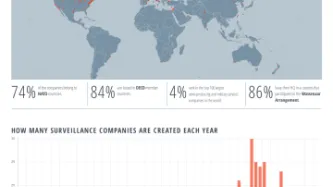
Privacy International is today proud to release the Surveillance Industry Index (SII), the world's largest publicly available educational resource of data and documents of its kind on the surveillance industry, and an accompanying report charting the growth of the industry and its current reach.
The SII, which is based on data collected by journalists, activists, and researchers across the world is the product of months of collaboration between Transparency Toolkit and Privacy…

Content type: Advocacy
Below is Privacy International’s oral statement to the Human Rights Council 31st ordinary session, 9 March 2016 Inter-active dialogue with the UN Special Rapporteur on the right to privacy. Privacy International's written statement is here.
BEGIN
Mr. President,
Privacy International welcomes the opportunity to participate in this first inter-active dialogue with the Special Rapporteur on the right to privacy. We regret however the Rapporteur’s late submission of his report.…
Content type: News & Analysis
This week will see the right to privacy take center stage at the UN in Geneva.
The UN Special rapporteur on the right to privacy will present his first report to the UN Human Rights Council on Wednesday 9 March. Meanwhile the Human Rights Committee will review the records of surveillance and the right to privacy of South Africa and Sweden among others.
The new Special Rapporteur on the right to privacy
A year ago the Human Rights Council established the mandate of the Special…
Content type: News & Analysis
In 2015 the United Nations' human rights mechanisms significantly increased their capacity to monitor and assess states' compliance with their obligations around the right to privacy. Notably, the Human Rights Council established the mandate of the Special Rapporteur on the right to privacy, filling a significant gap in the international human rights protection system. Meanwhile, the Human Rights Committee put surveillance laws and practices in a range of countries under close scrutiny, making…

Content type: News & Analysis
Today the Grand Chamber of the Court of Justice of the European Union ruled that mass surveillance is in violation of the right to privacy and that a legal system that provides no legal redress against interference with someone's privacy falls short of EU human rights standards.
The Court was seized following a complaint initiated by Mr Schrems to the Irish Data Protection Commissioner about the transfer of his Facebook data from Ireland to the US under the now defunct “…
Content type: News & Analysis
Today Privacy International together with other international human rights organisations call on the French parliament [PDF] to reject a bill on international surveillance, which, as it is currently worded, fails to protect and respect the right to privacy of individuals worldwide.
In June this year, the French parliament passed a law regulating the work of the intelligence services that will greatly undermine the privacy of French residents. Soon after, the French…

Content type: Advocacy
This stakeholder report is a submission by Privacy International (PI). PI is a human rights organisation that works to advance and promote the right to privacy and fight surveillance around the world. PI wishes to bring concerns about the protection and promotion of the right to privacy in France before the Human Rights Committee for consideration in France’s upcoming review.

Content type: News & Analysis
The French Government unveiled a new Bill that aims at providing a legal framework to intelligence services last Friday. While Privacy International welcomes the positive step of placing powers that were until now poorly regulated under the law, we remain alarmed by many aspects of this Bill. Two months after the deadly terrorist attacks in Paris that targeted the satirical weekly Charlie Hebdo and a Kosher supermarket, the Government seeks to provide the intelligence services with a…

Content type: News & Analysis
German surveillance technology company Trovicor played a central role in expanding the Ethiopian government's communications surveillance capacities, according to a joint investigation by Privacy International and netzpolitik.org.
The company, formerly part of Nokia Siemens Networks (NSN), provided equipment to Ethiopia's National Intelligence and Security Service (NISS) in 2011 and offered to massively expand the government's ability to intercept and store internet…

Content type: News & Analysis
The following was written by Mike Rispoli, Communications Manager at Privacy International, and appeared in the 'Journalism in Europe' discussion series, hosted by Central European University:
"The response by world leaders to the horrific terrorist attacks in France earlier this month has been all too familiar. As officials rallied for freedom of expression, they called for increased vigilance against extremists by expanding government surveillance powers.
Leading the way is UK Prime…
Content type: Press release
Privacy International, Reporters Without Borders, Digitale Gesellschaft, FIDH, and Human Rights Watch welcome news that the European Commission will move ahead and add specific forms of surveillance technology to the EU control list on dual use items, thus taking steps to finally hold companies to account who sell spy equipment and enable human rights abuses.
These important steps demonstrate that policymakers are beginning to wake up to the real harm that exists…

Content type: News & Analysis
The European Union’s privacy and data protection laws are some of the strongest in the world. And the privacy-related activities of the last European Parliament (2009-2014) have been the most intense in its history. For half of its term it steered the highly-debated data protection law reforms, with a first plenary vote cast in the nick of time before it dissolved last April. And for the last year it dealt with the fallout of the mass surveillance revelations by Edward Snowden, which…