
Search
Content type: Explainer
Following sustained reporting by researchers, journalists and activists around the world, including recent disclosures exposed by the PegasusProject, the surveillance industry is facing scrutiny like never before.
In the latest move, eighteen U.S. lawmakers have today demanded that the U.S. government imposes sanctions on four non-US surveillance companies for, as they mention in their letter, facilitating “disappearance, torture and murder of human rights activists and journalists”.
The move…

Content type: Video
<br />
Links
Read more about the ICO's provisional decision
Support our work
You can find out more about Clearview by listening to our podcast: The end of privacy? The spread of facial recognition

Content type: Long Read
Zimbabwe has a history of state led surveillance that is carried out more for political gain than for the investigation of legitimate criminal activities. During former President Mugabe’s 37 year rule the government used laws and state security structures to carry out targeted surveillance of persons of political interest and more generalised mass surveillance of the population.
Specific laws such as the Interception of Communications Act as well as mandatory SIM-card registration regulations…

Content type: News & Analysis
As Amnesty International and Forbidden Stories continue to publish crucial information about the potential targets of NSO Group’s spyware, we know this much already: something needs to be done.
But what exactly needs to be done is less obvious. Even though this is not the first time that the world has learned about major abuses by the surveillance industry (indeed, it’s not even the first time this month), it’s difficult to know what needs to change.
So how can the proliferation and use of…

Content type: Press release
Amnesty International, Privacy International and The Centre for Research on Multinational Corporations (SOMO) have published a report uncovering NSO Group’s entire corporate structure, tracking the global money trail of both public and private investment into the lucrative spyware company.
Amnesty International and other rights groups have documented dozens of cases of NSO Group’s products being used by repressive governments across the world to put activists, journalists, and opposition…

Content type: Advocacy

Content type: Report
In this briefing, Amnesty International, PI and The Centre for Research on Multinational Corporations (SOMO) discuss the corporate structure of NSO group, one of the surveillance industry's well-known participants. The lack of transparency around NSO Group’s corporate structure and the lack of information about the relevant jurisdictions within which it operates are significant barriers in seeking prevention of, and accountability for, human rights violations reportedly linked to NSO Group’s…
Content type: Examples
Sidestepping the need to obtain a search warrant, the US Department of Homeland Security (DHS) has been accessing smartphone location data by buying it from private marketing that typically embed tracker in apps. This data, which maps the movement of millions of cellphones in America, was collected from ordinary cellphone apps, to which users gave access to their location. In this particular instance, it was used by the DHS to search for undocumented immigrants according to the Wall Street…
Content type: Report
Privacy International has released a report summarising the result of its research into the databases and surveillance tools used by authorities across the UK’s borders, immigration, and citizenship system.
The report uses procurement, contractual, and other open-source data and aims to inform the work of civil society organisations and increase understanding of a vast yet highly opaque system upon which millions of people rely.
It also describes and maps…

Content type: Long Read
Privacy International’s new report shows how countries with powerful security agencies are training, equipping, and directly financing foreign surveillance agencies. Driven by advances in technology, increased surveillance is both powered by and empowering rising authoritarianism globally, as well as attacks on democracy, peoples’ rights, and the rule of law.To ensure that surveillance powers used by governments are used to protect rather than endanger people, it is essential that the public,…

Content type: Impact Case Study
What is the problem
For over two decades we have been documenting an alarming use and spread of surveillance. It is no longer just the wars on terror or drugs or migration that is driving this trend. The management of health crises and distribution of welfare regularly are among others being used to justify this turn to increasingly invasive forms of surveillance. From country to country we see the same ideas and the same profiteers expanding their reach.
When we first released our report on…

Content type: Long Read
Image: Eric Jones
The UK government last week hosted hundreds of surveillance companies as it continues to try and identify “technology-based solutions” able to reconcile the need for controls at the Irish border with the need to avoid them.
The annual showcase conference of 'Security and Policing' brings together some of the most advanced security equipment with government agencies from around the world. It is off limits to the public and media.
This year’s event came as EU and UK…
Content type: Explainer
What is the Global Surveillance Industry?
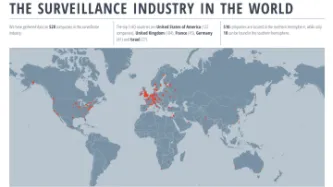
Today, a global industry consisting of hundreds of companies develops and sells surveillance technology to government agencies around the world. Together, these companies sell a wide range of systems used to identify, track, and monitor individuals and their communications for spying and policing purposes. The advanced powers available to the best equipped spy agencies in the world are being traded around the world. It is a…
Content type: News & Analysis
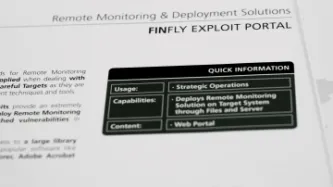
Private surveillance companies selling some of the most intrusive surveillance systems available today are in the business of purchasing security vulnerabilities of widely-used software, and bundling it together with their own intrusion products to provide their customers unprecedented access to a target’s computer and phone.
It's been known for some time that governments, usually at a pricey sum, purchase such exploits, known as zero- and one-day exploits, from security researchers to…
Content type: Case Study
What happened
As we traveled the world we saw alarming use and spread of surveillance capabilities. From country to country we saw the same policy ideas, and the same kit. The role of industry to the growth of surveillance capability had never been exposed before.
What we did
In 1996 we published the first ‘Big Brother Incorporated’ study, identifying the vast numbers of technology firms who were investing in surveillance technologies. We were particularly surprised by the rise of German…