
Search

Content type: Long Read
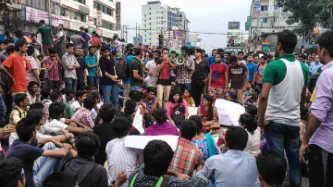
Privacy International’s new report shows how countries with powerful security agencies are training, equipping, and directly financing foreign surveillance agencies. Driven by advances in technology, increased surveillance is both powered by and empowering rising authoritarianism globally, as well as attacks on democracy, peoples’ rights, and the rule of law.To ensure that surveillance powers used by governments are used to protect rather than endanger people, it is essential that the public,…
Content type: Long Read
Creative Commons Photo Credit: Source
UPDATE: 30 July 2019
Privacy International has identified the following:
Two RAB officers received approval to travel to the USA in April 2019 for training on “Location Based Social Network Monitoring System Software for RAB Intelligence Wing”
Three RAB officers received approval to travel to Russia in August 2017 to participate in user training of “Backpack IMSI Catcher (2G, 3G, 4G)” paid for by Annex SW Engineering, a…
Content type: Press release
Privacy International, represented by Liberty, is challenging court decision allowing police to ‘neither confirm nor deny’ they hold certain information on IMSI catchers
Privacy rights organisation has fought for almost two years for public disclosure of records on how UK police purchase and use mobile phone surveillance technology
Privacy International has today filed an appeal challenging police forces’ refusal to disclose information on their purchase and use of IMSI catchers.
IMSI…
Content type: Report
The Information Commissioner’s Office (ICO) recently issued a series of decisions in Privacy International’s long-running battle for information about UK police forces' acquisition of IMSI catchers. This case study provides an in-depth summary and analysis of this process.
We hope it is useful to both campaigners seeking greater transparency from policing bodies, and more widely to Freedom of Information campaigners who are trying to challenge 'neither confirm nor deny' responses to FOI…
Content type: News & Analysis
Create Commons Photo Credit: Source
Privacy International has achieved an important victory for government transparency and information access rights. This victory stems from a long-running battle with the government to obtain information about the UK police’s purchase and use of IMSI catchers. The Information Commissioner’s Office (ICO) recently issued a series of decisions, which agree with Privacy International that police forces cannot rely on a position of “neither confirm nor deny” (NCND…
Content type: Explainer
What is an IMSI catcher?
An IMSI catcher is an intrusive piece of technology that can be used to locate and track all mobile phones that are switched on in a certain area.
An IMSI catcher does this by ‘pretending’ to be a mobile phone tower - tricking your phone into connecting to the IMSI-catcher, and then revealing your personal details without your knowledge.
IMSI catchers are indiscriminate surveillance tools that could be used to track who attends a political demonstration or a…

Content type: Press release
We found this image here.
The National Police Chiefs’ Council (NPCC) will no longer be able to operate in secret after human rights campaign organisations Liberty and Privacy International demanded it be subject to Freedom of Information laws.
The Government has now informed the organisations that it has started a process to designate the law enforcement policy-making body as a public authority subject to the Freedom of Information Act (FOIA) – meaning it will be open to public scrutiny.…

Content type: Long Read
How would you feel if you were fingerprinted by the police before you were allowed to take part in a peaceful public demonstration?
As tens of thousands of people attend massive public demonstrations across the UK today against US President Donald Trump in a ‘Carnival of Resistance’, it’s a question worth asking. Why? Because the police now deploy a range of highly sophisticated surveillance tools at public events which are just as if not more intrusive. And these technologies should be even…

Content type: Long Read
Privacy and data protection are currently being debated more intensively than ever before. In this interview, Frederike Kaltheuner from the civil rights organisation Privacy International explains why those terms have become so fundamentally important to us. The article was first published in the newly launched magazine ROM. The interview was conducted by ROM publisher Khesrau Behroz and writers Patrick Stegemann and Milosz Paul Rosinski.
Frederike Kaltheuner, you work for Privacy…
Content type: Course Section
Communications surveillance is where a third party intercepts a communication in the course of its transmission between intended recipients. Interception includes all acts of monitoring, copying, diverting, duplicating and storing communications in the course of their transmission by or for law enforcement or intelligence agencies.[1]
When discussing communications surveillance, there are many debates, distinctions, and terms used. Because of this it is important to know what a term represents…
Content type: Course Section
CONCEPTS
Communications surveillance: Communications surveillance is the monitoring, interception, collection, preservation and retention of information that has been communicated, relayed or generated over communications networks to a group of recipients by a third party. This includes phone calls, emails, text messages, pictures, and messaging apps.
Data protection: Data protection is the law designed to protect your personal information, which is collected, processed and stored by “…
Content type: News & Analysis
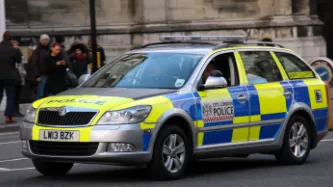
In order to uphold the law and keep us safe, the police can seriously interfere with a range of fundamental human rights. And so transparency and public scrutiny of their actions are essential to protect against misconduct and abuse.
So why is the National Police Chiefs’ Council (NPCC) now permitted to operate in secret?
We all have the right to seek information from most public bodies – including the police – under the Freedom of Information Act (FOIA) 2000. When the law was first…
Content type: Long Read
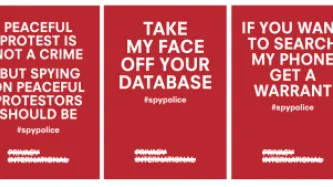
TO TAKE PART IN OUR CAMPAIGN, RIGHT CLICK ON THE PICTURES BELOW, SAVE THEM, AND SHARE THEM ON SOCIAL MEDIA TAGGED #SPYPOLICE
Have you ever been to a peaceful protest, demo or march? Did you assume that the police would only be identifying 'troublemakers'? How would you feel if just by turning up at a peaceful protest, the police automatically identified you, without your consent or knowledge, and stored personal information about you (including photographs of your face) in a secret database?…
Content type: News & Analysis
This op-ed originally appeared in the New Statesman.
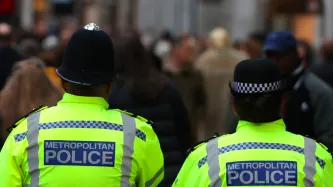
Imagine the police searching your home without good reason, without a warrant, without your knowledge. For good measure let’s also imagine that they take a full inventory of all of your possessions and store this in a secret database indefinitely.
A peculiar feature of modernity is that what we would find dystopian in the real world is banal in our virtual world. And the irony is that this can be a greater violation of our privacy and…

Content type: Long Read
Image: Eric Jones
The UK government last week hosted hundreds of surveillance companies as it continues to try and identify “technology-based solutions” able to reconcile the need for controls at the Irish border with the need to avoid them.
The annual showcase conference of 'Security and Policing' brings together some of the most advanced security equipment with government agencies from around the world. It is off limits to the public and media.
This year’s event came as EU and UK…
Content type: Explainer
Phone networks are divided between two networks: the physical and the mobile. The physical runs on the Public Switched Telephone Network (PSTN) that serves your home phone. Mobile networks are dominant in the age of communication and are used to relay mobile communications to the PSTN. The most prominent mobile networks are GSM networks (Global System for Mobile communications) and are what we use everyday to communicate with one another. Another system is known as CDMA (Code Division Multiple…

Content type: Explainer
Video surveillance technologies are deployed in public and private areas for monitoring purposes. Closed-circuit television (CCTV)– a connected network of stationary and mobile video cameras– is increasingly used in public areas, private businesses and public institutions such as schools and hospitals. Systems incorporating video surveillance technologies have far greater powers than simply what the camera sees. Biometric technologies use the transmitted video to profile, sort and identify…