
Search
Content type: Examples
Article extract:
"French laws designed to prohibit individual-level targeting are circumvented by services like those provided by Paris-based firm Liegey Muller Pons, which aggregates personal data. Such services are no less data-intensive than those unconstrained by such legal requirements."
"• Liegey Muller Pons (LMP) is a digital campaigning firm that has provided services to over 1,000 campaigns across six European countries. French law prohibits individual-level targeting except under…

Content type: Long Read
Among the many challenges of 2020, the impact on elections around the world kept us all on the edge of our seats. 75 countries postponed national and local elections due to Covid 19. Of the elections that went ahead, we saw Covid safe measures at polling stations (South Korea led the way forward in April) an increase in postal voting (who can forget the USA, but also Poland) and political parties in Uganda conducting "virtual" campaigns as mass rallies and in person campaign meetings were…
Content type: Long Read
Political parties depend on data to drive their campaigns, from deciding where to hold rallies, which campaign messages to focus on in which area, and how to target supporters, undecided voters and non-supporters, including with ads on social media. Political parties increasingly hire private companies to do the bulk of this work, and our primary concern is how these companies use personal data to “profile” people and drive election campaigning.
As part of PI’s programme of work on Defending…

Content type: Press release
Privacy International announces the launch of two reports as part of its work on Defending Democracy and Dissent.
The report Online Political Ads: A study of inequality in transparency standards builds on our 2019 research findings and delves into the adverse impacts of non-existent or limited transparency on democracy based on two case-studies developed by our partners InternetLab and ELSAM.
The report, Micro-Targeting in Political Campaigns,…
Content type: Report
This paper examines the various legal frameworks governing micro-targeting in political campaigns in six states: Canada, Brazil, France, Italy, Spain and the UK. It aims to assess national practices as well as point out gaps in their respective frameworks. The paper commences by examining how micro-targeting is defined and thereafter examines the legal provisions applicable to micro-targeting activities.
To do this in an accessible way, the paper follows and analyses the series of activities…
Content type: Advocacy
Dear Chair and Committee colleagues,
Privacy International is an international NGO, based in London, which works with partners around the world to challenge state and corporate surveillance and data exploitation. As part of our work, we have a dedicated programme “Defending Democracy and Dissent” where we advocate for limits on data exploitation throughout the electoral cycle.
We have been closely following the important work of the Committee. Prompted by the additional evidence provided…
Content type: Long Read
The UK public, regulators, and parliamentarians have all expressed concern about the wide use of third-party data by all political parties in the UK and its impact on privacy and democracy. In the week the remaining six candidates to be the UK’s next Prime Minister are reduced to two, Privacy International takes a look at their privacy policies to illustrate how such policies can be used to identify the use of third-party data by political candidates from all political parties.
The…
Content type: Long Read
Image Source: "Voting Key" by CreditDebitPro is licensed under CC BY 2.0
Democratic society is under threat from a range of players exploiting our data in ways which are often hidden and unaccountable. These actors are manifold: traditional political parties (from the whole political spectrum), organisations or individuals pushing particular political agendas, foreign actors aiming at interfering with national democratic processes, and the industries that provide products that …

Content type: News & Analysis
The first half of 2018 saw two major privacy moments: in March, the Facebook/ Cambridge Analytica scandal broke, followed in May by the EU General Data Protection Regulation ("GDPR") taking effect. The Cambridge Analytica scandal, as it has become known, grabbed the attention and outrage of the media, the public, parliamentarians and regulators around the world - demonstrating that yes, people do care about violations of their privacy and abuse of power. This scandal has been one of…

Content type: Examples
According to research conducted by Ronan Chardonneau, a French associate professor of digital marketing at Angers University, none of the websites of the eleven candidates' in the 2017 French presidential elections, that he looked into respected CNIL's directives regarding information that should be available on the website and consent requirements for data collection. According to this research, nine of the candidates used Google Analytics, without activating the option to anonymize data…

Content type: Examples
A company called Liegey Muller Pons (LMP) offers data analysis tools to help candidates and political parties improve their political campaign strategy. The three founders of the company were member's of former President François Hollande's 2012 campaign team. LMP was then hired by current President Emmanuel Macron during his Grande Marche campaign before the elections and during the presidential elections by the Socialist Party candidate Benoît Hamon. LMP offers data analysis that allows…

Content type: Examples
NationBuilder is an American political campaigning software company, which offers a fully integrated suite of tools for the organization of a campaign, and outreach through e-mail, telephone, social media, and traditional door-to-door campaigning. Many candidates in the 2017 French presidential elections were reported as using their services. Among others, the company offers a functionality called 'match'. When users provide their email address on a campaign's website, 'match' allows the…

Content type: Examples
During the primary elections in November 2016, the former French president, Nicolas Sarkozy, reportedly used an app, called Knockin, that made it possible to identify and geolocate supporters for door-to-door campaigning. Based on a report by the French Radio RMC, the app would harvest public data about anyone that liked a page or a post that the candidate put on his campaign page in order to find the supporter's address. Door-to-door volunteers were then able to see on the app the address…
Content type: Long Read
This image was found here.
Spain is holding a national general election on April 28 (its third in four years). Four weeks later Spaniards will again go to the polls to vote in the European Parliament elections. At Privacy International we are working to investigate and challenge the exploitation of people’s data in the electoral cycle including in political campaigns. This includes looking at the legal frameworks governing the use of data by political parties and their…

Content type: Examples
In 2014, when the the far-right party of French politician Marine Le Pen needed cash, the loan of €9.4 million came from First Czech-Russian Bank, which was founded in the early 2000s as a joint venture between a Czech state bank and a Russian lender and went on to come under the personal ownership of Russian financier Roman Popov and obtain a European license via a subsidiary in the Czech Republic. Two and a half months after the Le Pen loan was signed, a Mediapart investigative journalist…

Content type: Examples
In November 2018, the Spanish senate approved 220-21 an online data protection law intended to ensure compliance with the General Data Protection Regulation with an added amendment that allowed political parties to use personal data obtained from web pages and other publicly accessible sources for political purposes during campaign periods. Spain's Platform for the Defence of Freedom of Information criticised the law's potential to allow parties to create ideological profiles and emulate the…

Content type: Examples
Facebook and Twitter have advised Damian Collins, the chair of the UK Parliament's digital, culture, media, and sport committee, that the companies will hand over some information relating to the rearch of Russia-backed posts during the EU referendum. Facebook has already given the US Senate similar information about Russia-backed posts during the 2016 presidential election; this information showed that campaign ads and fake news generated by the Internet Research Agency troll factory in St…
Content type: Long Read
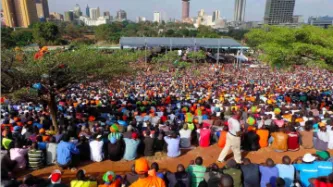
The battle for Kenyan voters’ allegiance in the 2017 Presidential election was fought on social media and the blogosphere. Paid advertisements for two mysterious, anonymous sites in particular started to dominate Google searches for dozens of election-related terms in the months leading up to the vote. All linked back to either “The Real Raila”, a virulent attack campaign against presidential hopeful Raila Odinga, or Uhuru for Us, a site showcasing President Uhuru Kenyatta’s accomplishments. As…
Content type: Press release
A new investigation published today by Privacy International reveals the role of an American data-based digital advertising company in the highly divisive online re-election campaign of Kenyan president Uhuru Kenyatta.
In the run-up to Kenya's presidential election in August 2017, paid advertisements for two mysterious sites dominated Google searches for election-related terms and flooded Kenyans' social media feeds. All linked back to either 'The Real Raila', a virulent attack campaign…
Content type: News & Analysis
30 May 2017
These days it seems that no election can go by without fears of foul play, whether it is the hacking of a candidate or party’s e-mail or the spread of fake news and other misinformation to support or discredit a particular party or politician.
Often the finger is pointed at shady individuals or rogue governments , and invariably the accusations are met with flat denial. But the accusations have attracted significant attention from governments and companies alike, with reactions…