
Search

Content type: News & Analysis
Brexit and Privacy
It's as clear as mud, what it means when a country decides to willingly pull out of a trading bloc, a policy coordination mechanism, a relatively democratic network, and a framework for the free flow of people, data, and rights. Meanwhile today the minister in charge of surveillance for the past six years will assume the leadership of the country.
There is much speculation as to what is next. Here's our take. Importantly, there's a lot to be worried about, some to like…
Content type: Press release
For further information please contact PI Legal Officer Millie Graham Wood: [email protected]
For media enquiries please contact [email protected]
Documents obtained by Privacy International reveal the existence of a secret oversight function given to the Intelligence Services Commissioner (ISC), in operation since at least 2014. The details of this function, referred to as the ‘third direction’, remain redacted and only came to light following…
Content type: Press release
Privacy International has today written to government ministers, members of the opposition, and oversight bodies reaffirming its call for the UK government to reveal secret intelligence sharing arrangements with the United States.
The original UKUSA agreement — drafted shortly after World War II — allows UK and US agencies to share, by default, any raw intelligence, collection equipment, decryption techniques, and translated documents.
Current arrangements also allow US…

Content type: Long Read
This piece was written by Ashley Gorski, who is an attorney at the American Civil Liberties Union, and PI legal officer Scarlet Kim and originally appeared in The Guardian here.
In recent weeks, the Hollywood film about Edward Snowden and the movement to pardon the NSA whistleblower have renewed worldwide attention on the scope and substance of government surveillance programs. In the United States, however, the debate has often been a narrow one, focused on the…
Content type: Long Read
On 17 October 2016, the Investigatory Powers Tribunal handed down judgment in a case brought by Privacy International against the Foreign Secretary, the Home Secretary and the three Security and Intelligence Agencies (MI5, MI6 and GCHQ).
The case concerned the Agencies’ acquisition and use of bulk personal datasets (‘BPD’) – datasets that contain personal data about individuals, the majority of whom are unlikely to be of intelligence interest, such as passport databases and finance-related…

Content type: Long Read
This week, Privacy International, together with nine other international human rights NGOs, filed submissions with the European Court of Human Rights. Our case challenges the UK government’s bulk interception of internet traffic transiting fiber optic cables landing in the UK and its access to information similarly intercepted in bulk by the US government, which were revealed by the Snowden disclosures. To accompany our filing, we have produced two infographics to illustrate the…
Content type: Press release
Key points
Privacy International, Liberty, Amnesty International, and seven other human rights organizations challenge UK mass surveillance and UK access to US mass surveillance at the European Court of Human Rights
This is the first case before the European Court of Human Rights to directly challenge UK and US mass surveillance revealed by the Snowden disclosures
National courts and oversight bodies have failed to rein in mass surveillance practices that impact hundreds of millions of…
Content type: Press release
Today, Privacy International, together with five internet and communications providers from around the world, have lodged an application before the European Court of Human Rights to challenge the British Government's use of bulk hacking abroad. Until we brought our original case at the Investigatory Powers Tribunal (IPT) in 2014, the Government had never admitted that it engaged in hacking. Now we are learning for the first time how far-reaching the Government's global hacking capabilities are…
Content type: News & Analysis
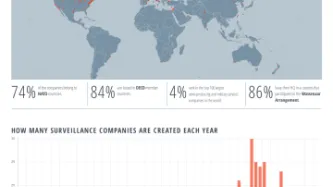
Privacy International is today proud to release the Surveillance Industry Index (SII), the world's largest publicly available educational resource of data and documents of its kind on the surveillance industry, and an accompanying report charting the growth of the industry and its current reach.
The SII, which is based on data collected by journalists, activists, and researchers across the world is the product of months of collaboration between Transparency Toolkit and Privacy…
Content type: Long Read
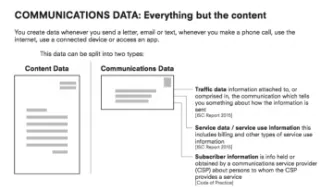
Privacy International’s case on Bulk Personal Datasets and Bulk Communications Data comes to a head with a four-day hearing in the Investigatory Powers Tribunal which commenced on 26 July 2016.
The litigation has brought to light significant revelations about the use of section 94 of the 1984 Telecommunications Act to obtain bulk communications data.
Large amounts of disclosure have shed new light on this hitherto secret power and explained confusing aspects of the Government’s Response to…
Content type: News & Analysis
One of the most controversial aspects of the UK's Investigatory Powers Bill proposes the storing by ISPs and mobile network providers of 'Internet Connection Records' (ICRs). While vaguely defined, they will include your internet browsing history (although the Government is at pains to clarify that only the websites you visit, not the specific webpages on those websites will be stored), and what apps you have accessed, over the previous 12 months.
Clearly then ICRs are personal…
Content type: Press release
Today Sir Stanley Burnton, the Interception of Communications Commissioner, published a highly critical review of the use of Section 94 of the Telecommunications Act 1984 for gathering vast amounts of our communications data in bulk. This obscure clause pre-dates the internet era, but has been used for nearly two decades for mass surveillance. Today is the first time that these powers have been criticised by an independent statutory body. IOCCO is critical of the Government's use of these…

Content type: Long Read
This piece originally appeared here.
On both sides of the Atlantic, we are witnessing the dramatic expansion of government hacking powers. In the United States, a proposed amendment to Rule 41 of the Federal Rules of Criminal Procedure would permit the government to obtain a warrant, in certain circumstances, to hack unspecified numbers of electronic devices anywhere in the world. Meanwhile, across the pond, the British Parliament is currently debating the Investigatory…
Content type: Press release
Judges of the Investigatory Powers Tribunal visited MI5 in 2007 for a secret briefing. None of the judges hearing the case this week attended the briefing.
At the briefing, MI5 persuaded the judges that MI5 did not usually have to disclose its data holdings in “Bulk Personal Datasets” to the Tribunal. These are highly intrusive datasets that have details of a vast number of people's location, internet use, financial information and telephone records.
This meant that, as complaints were…
Content type: Press release
Tomorrow, on 26 July, the main hearing will begin in Privacy International's legal challenge against MI6, MI5, and GCHQ's collection of bulk communications data and bulk personal datasets. Previously secret documents will be made public at the hearing, and Privacy International will brief attending journalists about the significance of the disclosed documents.
The hearing will include references to important documents detailing the collection of data on every citizen in the…
Content type: Press release
Harmit Kambo, Campaigns Director, Privacy International said
"The overwhelming vote by MPs last night in favour of massively intrusive new state surveillance powers represents both a failure of the democratic process and a grim watershed moment for the privacy of every one of us.
Over the course of the Bill Committee stage, Privacy International, alongside experts from academia, technology firms, the legal profession, human rights organisations, and civil liberties groups have proposed over…
Content type: Press release
Privacy International releases previously confidential correspondence between lawyers for MI5 and GCHQ and the former Interception of Communications Commissioner, highlighting problems with the relationship between the two bodies
The correspondences show a lack of meaningful oversight and restraint of UK surveillance agencies
Ahead of the vital commons vote on the Investigatory Powers Bill, we need to create a system that guarantees better oversight of surveillance powers…
Content type: Press release
Despite Government attempts to stop 650 claims about surveillance being investigated, the Investigatory Powers Tribunal has today ruled that the cases can be heard
However, the Tribunal is requiring the 650 claimants to submit further information demonstrating that they are "potentially at risk" of unlawful surveillance, prior to investigating their claims of unlawful spying
The Tribunal has said that people outside the UK have no legal right to find out if British…

Content type: News & Analysis
This letter originally appeared here.
Dear Home Secretary
You are fortunate that the SNP and Labour Party courageously abstained from the vote on the Investigatory Powers Bill, content with government assurances that mass surveillance of British citizens is not government policy. Mass surveillance is not, and could never be, government policy. Merely government practice.
I congratulate you on your much-quoted claim that the Investigatory Powers Bill will contain a “world-leading…
Content type: Press release
Privacy International, the leading global privacy rights NGO, has today filed a Judicial Review at the UK High Court, challenging the Investigatory Powers Tribunal's (IPT) decision that the Government can issue general hacking warrants. This decision means that British intelligence agency GCHQ can continue to hack into the computers and phones of broad classes of people - including those residing in the UK. The Investigatory Powers Bill, currently being debated in Parliament, seeks to…

Content type: News & Analysis
“It’s like 10,000 spoons when all you need is a knife”. Alanis Morissette thought that was ironic. I never thought so. I suggest a far more ironic lyric to you Alanis - "It’s like the Home Office not listening during a consultation about how it wants to listen to everything you do’. OK, it might not be the catchiest lyric, but you can’t say it’s not ironic.
Today the latest version of the Investigatory Powers Bill was published. The Government might want some credit…
Content type: Long Read
1984: A broad law, a broad power and a whole lot of secrecy
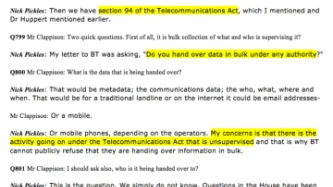
In the wake of litigation brought by Privacy International (‘PI’) and as the Government prepared to introduce the Draft Investigatory Powers Bill (‘IP Bill’) in November 2015, there was a cascade of ‘avowals’- admissions that the intelligence agencies carry out some highly intrusive surveillance operations under powers contained in outdated and confusing legislation.
It is disappointing that it has been almost six months since…
Content type: News & Analysis
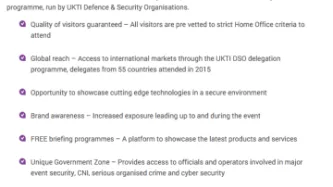
Surveillance companies and government officials from across the world are gathering in the UK this week at the invitation of the Home Office for the UK’s “Premier Security and Law Enforcement Event’, one week after the controversial spying legislation, entitled the Investigatory Powers Bill, had its first reading in Parliament.
Delegates and companies will be attending the three-day long ‘Security and Policing’ trade show in Farnborough, the historical centre of the UK’s aerospace industry.…

Content type: Advocacy
In his first report to the UN Human Rights Council (the main UN human rights political body composed of 47 states from around the world), the UN Special Rapporteur on the Right to Privacy has offered a scathing critique on the UK Investigatory Powers Bill. In particular the Rapporteur noted how bulk surveillance powers, including bulk hacking, are disproportionate and violate the right to privacy as established by human rights courts. The Rapporteur noted that the powers proposed in the…

Content type: News & Analysis
The Investigatory Powers Bill introduced on Tuesday 1 March contains the same range of ‘bulk powers’ envisaged in the earlier draft: bulk interception warrants; bulk acquisition warrants; bulk equipment interference warrants; and bulk personal dataset warrants.
These powers, if adopted as currently envisaged in the Bill, would codify a practice of mass, untargeted surveillance by the UK intelligence services.
In the last couple of years, some of the mass surveillance powers used by…
Content type: Long Read
The Investigatory Powers Tribunal (“IPT”) today held that GCHQ hacking of computers, mobile devices and networks is lawful, wherever it occurs around the world. We are disappointed that the IPT has not upheld our complaint and we will be challenging its findings.
Our complaint is the first UK legal challenge to state-sponsored hacking, an exceptionally intrusive form of surveillance. We contended that GCHQ hacking operations were incompatible with democratic principles and human rights…
Content type: News & Analysis
The problems with thematic warrants and why they should be removed from the UK Government’s Investigatory Powers Bill
We currently have the rare opportunity to scrutinise and debate the powers that law enforcement, the security and intelligence agencies and public bodies should have to interfere with our private communications, our devices and our digital lives. These powers are being enshrined and expanded upon in the draft Investigatory Powers Bill (IP Bill), currently under scrutiny by the…
Content type: Press release
Gus Hosein, Executive Director, Privacy International said:
“Parliament's Intelligence and Security Committee (ISC) has today slammed the Government’s draft Investigatory Powers Bill for its lack of transparency, lack of clarity and lack of privacy protections. We urge the Home Office to take on board the wide ranging criticisms that the tech sector, civil society, and now even the Parliamentary committee that oversees the surveillance capabilities of the intelligence agencies, have made of…

Content type: News & Analysis
In 2015 the United Nations' human rights mechanisms significantly increased their capacity to monitor and assess states' compliance with their obligations around the right to privacy. Notably, the Human Rights Council established the mandate of the Special Rapporteur on the right to privacy, filling a significant gap in the international human rights protection system. Meanwhile, the Human Rights Committee put surveillance laws and practices in a range of countries under close scrutiny, making…