
Search
Content type: Report
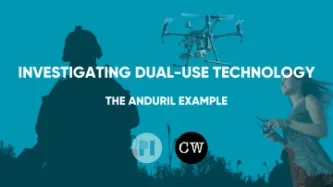
Technologies that have both military and civilian applications are known as "dual-use”. Drone start-ups, arms giants, and satellite manufacturers are among the tech companies which are increasingly marketing surveillance products for both military and civil applications, leading to a blurring of the lines between the two domains. This has serious implications for our freedoms, and the militarisation of our societies, and the use of publicly-funded research.Exploring the growing influence of…

Content type: Long Read
Tucked away in a discrete side street in Hungary’s capital, the European Union Agency for Law Enforcement Training (CEPOL) has since 2006 operated as an official EU agency responsible for developing, implementing, and coordinating training for law enforcement officials from across EU and non-EU countries.
Providing training to some 29,000 officials in 2018 alone, it has seen its budget rocket from €5 million in 2006 to over €9.3 million in 2019, and offers courses in everything from…
Content type: Long Read
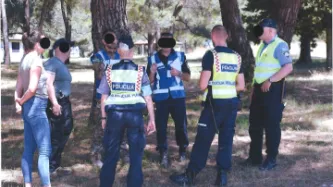
The European Union (EU) is the world’s largest donor of development aid, an instrumental supporter of democracies and peace around the world, and a powerful global force for reigning-in big tech and other exploitative industries. But since the 2015 migration crisis and with populist anti-immigration parties in power across the Union, it has focused this immensely powerful influence abroad squarely on managing flows of migration: using its economic, diplomatic, and security might to…

Content type: Report
The majority of people today carry a mobile phone with them wherever they go, which they use to stay connected to the world. Yet an intrusive tool, known as an International Mobile Subscriber Identity catcher, or “IMSI catcher” is a form of surveillance equipment that enables governments and state authorities to conduct indiscriminate surveillance of mobile devices, and by extension, on users.
IMSI catchers can do much more than monitor and intercept mobile communications. Designed to imitate…

Content type: Long Read
image from portal gda (cc)
Many people are still confused by what is 5G and what it means for them. With cities like London, New York or San Francisco now plastered with ads, talks about national security, and the deployment of 5G protocols being treated like an arms race, what happens to our privacy and security?
5G is the next generation of mobile networks, which is meant to be an evolution of the current 4G protocols that mobile providers have deployed over the last decade, and there are…
Content type: Long Read
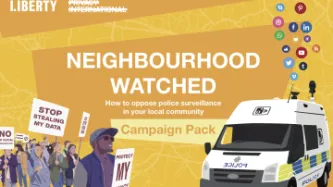
Join our campaign with Liberty and write to your local Police and Crime Commissioner (PCC). Your PCC works on your behalf to hold your local police force to account, so you can share your concerns about police spying tech with them.You can download our new campaign pack (pdf link at the bottom of the page) to learn more about the police surveillance technology that might already be being used in your local area, and find out what you can do to get your police force to be more accountable to you…
Content type: Long Read
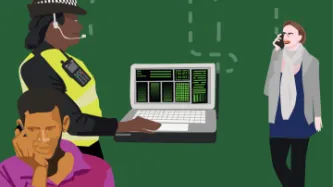
Imagine that every time you want to attend a march, religious event, political meeting, protest, or public rally, you must share deeply personal information with police and intelligence agencies, even when they have no reason to suspect you of wrongdoing.
First, you need to go to the police to register; have your photo taken for a biometric database; share the contacts of your family, friends, and colleagues; disclose your finances, health records, lifestyle choices, relationship status, and…
Content type: Long Read
Content type: Long Read
As calls for a ‘secure southern border’ are amplified in the US by politicians and pundits, Silicon Valley techies are coming out in force to proffer swanky digital solutions in the place of 30-foot steel slats or concrete blocks.
One such company is Anduril Industries, named after a sword in Lord of the Rings, which represents a symbol of hidden power.
Over recent months, Anduril Industries frontman Palmer Luckey has been making the PR rounds to promote his company’s version of a border wall…
Content type: Long Read
The Privacy International Network is celebrating Data Privacy Week, where we’ll be talking about how trends in surveillance and data exploitation are increasingly affecting our right to privacy. Join the conversation on Twitter using #dataprivacyweek.
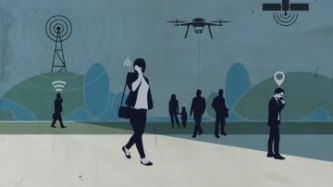
In the era of smart cities, the gap between the internet and the so-called physical world is closing. Gone are the days, when the internet was limited to your activities behind a desktop screen, when nobody knew you were a dog.
Today, the…

Content type: State of Privacy
Table of contents
Introduction
Right to Privacy
Communication Surveillance
Data Protection
Identification Schemes
Policies and Sectoral Initiatives
Introduction
Acknowledgement
The State of Privacy in Colombia is the result of an ongoing collaboration by Privacy International and Fundación Karisma and Dejusticia.
Key Privacy Facts
1. Constitutional privacy protection: The constitution contains an explicit protection of the right to privacy (Article 15 of the 1991 constitution).
2…

Content type: State of Privacy
Table of contents
Introduction
Right to Privacy
Communication Surveillance
Data Protection
Identification Schemes
Policies and Sectoral Initiatives
Introduction
Acknowledgment
The State of Privacy in South Africa is the result of an ongoing collaboration by Privacy International and the Right2Know coalition.
Key Privacy Facts
1. Constitutional privacy protections: Section 14 of the Constitution of the Republic of South Africa protects the right to privacy.
2. Data protection laws…

Content type: State of Privacy
Table of contents
Introduction
Right to Privacy
Communication Surveillance
Data Protection
Identification Schemes
Policies and Sectoral Initiatives
Introduction
Acknowledgement
The State of Privacy in the Philippines is the result of an ongoing collaboration by Privacy International and Foundation for Media Alternatives.
Key privacy facts
1. Constitutional privacy protection: The constitution contains an explicit protection of the right to privacy (Art. III, section 3).
2.…

Content type: State of Privacy
Table of contents
Introduction
Right to Privacy
Data Protection
Identification Schemes
Policies and Sectoral Initiatives
Introduction
Acknowledgment
The State of Privacy in Pakistan is the result of an ongoing collaboration by Privacy International and the Digital Rights Foundation.
Between 2014-2016, Bytes for All contributed to previous versions of the 'Data Protection' sections of this briefing.
Key Privacy Facts
1. Constitutional privacy protections: Article 14(1) of…

Content type: State of Privacy
Table of contents
Introduction
Right to Privacy
Communication Surveillance
Data Protection
Identification Schemes
Policies and Sectoral Initiatives
Introduction
Acknowledgment
The State of Privacy in Indonesia is the result of an ongoing collaboration by Privacy International and The Institute for Policy Research and Advocacy (ELSAM).
Key privacy facts
Key privacy facts
1. Constitutional privacy protection: The constitution does not explicitly mention privacy.
2. Data protection…
Content type: State of Privacy
Table of contents
Introduction
Right to Privacy
Communication Surveillance
Data Protection
Identification Schemes
Policies and Sectoral Initiatives
Introduction
Acknowledgement
The State of Privacy in Brazil is the result of an ongoing collaboration by Privacy International and Coding Rights.
Between 2014-2017, Privacy LatAm contributed to previous versions of this briefing.
Key privacy facts
1. Constitutional privacy protection: The constitution contains an explicit…

Content type: Long Read
Privacy International’s new report shows how countries with powerful security agencies are training, equipping, and directly financing foreign surveillance agencies. Driven by advances in technology, increased surveillance is both powered by and empowering rising authoritarianism globally, as well as attacks on democracy, peoples’ rights, and the rule of law.To ensure that surveillance powers used by governments are used to protect rather than endanger people, it is essential that the public,…
Content type: Long Read
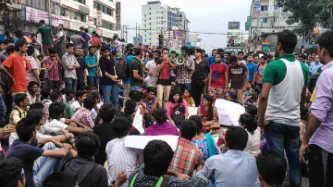
Creative Commons Photo Credit: Source
UPDATE: 30 July 2019
Privacy International has identified the following:
Two RAB officers received approval to travel to the USA in April 2019 for training on “Location Based Social Network Monitoring System Software for RAB Intelligence Wing”
Three RAB officers received approval to travel to Russia in August 2017 to participate in user training of “Backpack IMSI Catcher (2G, 3G, 4G)” paid for by Annex SW Engineering, a…
Content type: Report
The Information Commissioner’s Office (ICO) recently issued a series of decisions in Privacy International’s long-running battle for information about UK police forces' acquisition of IMSI catchers. This case study provides an in-depth summary and analysis of this process.
We hope it is useful to both campaigners seeking greater transparency from policing bodies, and more widely to Freedom of Information campaigners who are trying to challenge 'neither confirm nor deny' responses to FOI…

Content type: Long Read
How would you feel if you were fingerprinted by the police before you were allowed to take part in a peaceful public demonstration?
As tens of thousands of people attend massive public demonstrations across the UK today against US President Donald Trump in a ‘Carnival of Resistance’, it’s a question worth asking. Why? Because the police now deploy a range of highly sophisticated surveillance tools at public events which are just as if not more intrusive. And these technologies should be even…

Content type: Long Read
Privacy and data protection are currently being debated more intensively than ever before. In this interview, Frederike Kaltheuner from the civil rights organisation Privacy International explains why those terms have become so fundamentally important to us. The article was first published in the newly launched magazine ROM. The interview was conducted by ROM publisher Khesrau Behroz and writers Patrick Stegemann and Milosz Paul Rosinski.
Frederike Kaltheuner, you work for Privacy…
Content type: Long Read
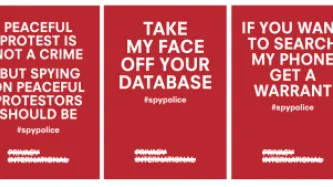
TO TAKE PART IN OUR CAMPAIGN, RIGHT CLICK ON THE PICTURES BELOW, SAVE THEM, AND SHARE THEM ON SOCIAL MEDIA TAGGED #SPYPOLICE
Have you ever been to a peaceful protest, demo or march? Did you assume that the police would only be identifying 'troublemakers'? How would you feel if just by turning up at a peaceful protest, the police automatically identified you, without your consent or knowledge, and stored personal information about you (including photographs of your face) in a secret database?…

Content type: Long Read
Image: Eric Jones
The UK government last week hosted hundreds of surveillance companies as it continues to try and identify “technology-based solutions” able to reconcile the need for controls at the Irish border with the need to avoid them.
The annual showcase conference of 'Security and Policing' brings together some of the most advanced security equipment with government agencies from around the world. It is off limits to the public and media.
This year’s event came as EU and UK…
Content type: Long Read
European Court of Human Rights Intervention
On 15 September 2017, Privacy International filed an intervention to the European Court of Human Rights in Association Confraternelle de la Presse Judiciare and 11 Other Applications v. France. This case challenges various surveillance powers authorised under the French Intelligence Act of 24 July 2015 as incompatible with Articles 8 and 10 of the European Convention on Human Rights, which respectively protect the right to privacy…
Content type: Long Read
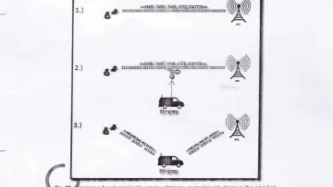
The use of IMSI catchers[1] to arrest individuals is rarely documented — as IMSI catchers are used secretively in most countries. The arrest of Colombian drug lord Henry López Londoño in Argentina is therefore a rare opportunity to understand both how IMSI catchers are used, and also the complexity of their extraterritorial use.
In October 2012, Londoño — also known as Mi Sangre (“My Blood”) — was arrested in Argentina. His arrest was the result of cooperation between the Dirección de…
Content type: Long Read
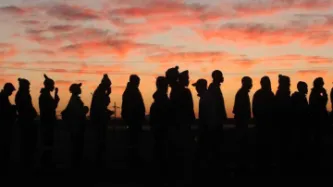
In July 2015, representatives of a private company met in a parking lot in Pretoria, South Africa to sell phone tapping technology to an interested private buyer. What they did not know was that this buyer was a police officer. The police had been tipped off that the company was looking to offload the surveillance technology, an IMSI catcher, to anyone who would buy it. It is illegal to operate such surveillance technology as a private citizen in South Africa, and illegal to buy…
Content type: Long Read
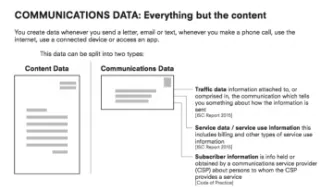
Privacy International’s case on Bulk Personal Datasets and Bulk Communications Data comes to a head with a four-day hearing in the Investigatory Powers Tribunal which commenced on 26 July 2016.
The litigation has brought to light significant revelations about the use of section 94 of the 1984 Telecommunications Act to obtain bulk communications data.
Large amounts of disclosure have shed new light on this hitherto secret power and explained confusing aspects of the Government’s Response to…
Content type: Long Read
This guest piece was written by Jessamine Pacis of the Foundation for Media Alternatives. It does not necessarily reflect the views or position of Privacy International.
Introduction
With a history immersed in years of colonialism and tainted by martial law, Philippine society is no stranger to surveillance. Even now, tales of past regimes tracking their citizens’ every move find their way into people’s everyday conversations. This, for the most part, has kept Filipinos…